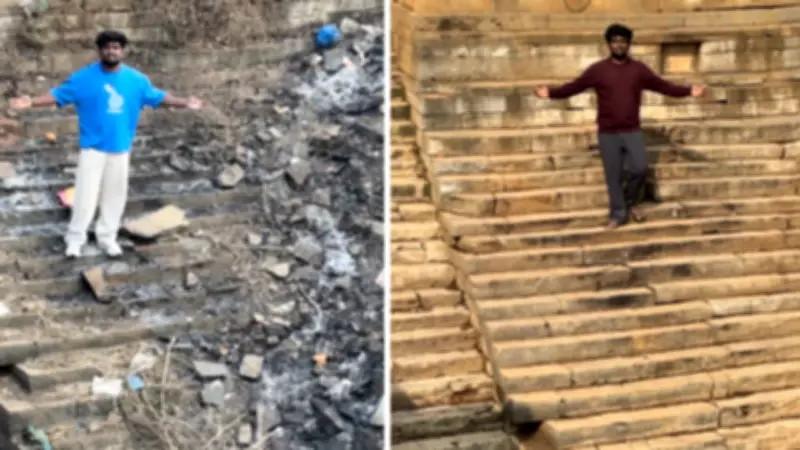
Ancient Andhra Stepwell Resurrected from Garbage by Community Volunteers
For decades, an ancient stepwell located in Peapully Mandal, Andhra Pradesh, lay completely buried under thick layers of accumulated garbage and refuse. What had once served as a vital water source and community gathering point had gradually deteriorated into an unofficial dumping ground, choked with plastic waste, discarded food wrappers, coconut shells, turmeric sachets, leaf plates, and flower garlands from nearby temple offerings.
The Catalyst for Change
The gradual erosion and neglect of this significant heritage site might have continued unnoticed if not for the intervention of social media influencer Abbayi Kanth. Frustrated by the deplorable condition of the historical well, Kanth decided to create and share a video that not only highlighted the extensive filth but also emphasized the cultural and historical loss represented by the stepwell's decay. His powerful appeal resonated widely and sparked immediate action.
Massive Volunteer Mobilization
Within days, over three hundred volunteers rallied under the banner of the Poorva Sampada Rakshaka Sena, an organization dedicated to heritage protection. This was not merely a symbolic cleanup but a coordinated, large-scale restoration effort. Volunteers arrived equipped with gloves, tools, and determination, climbing directly into the stepwell to manually clear out heaps of waste and debris that had accumulated over many years.

Teams worked in organized shifts, ensuring the project extended beyond a single day. Plastic and organic waste were removed systematically. As the cleaning progressed, the ancient stone steps, which had been completely hidden beneath dirt and refuse, slowly began to reappear. Circulating online videos captured villagers and youth groups meticulously washing the steps with water, carefully restoring the structure's original architectural form.
Shifting Local Perceptions
For many residents in the Nandyal district, the stepwell had long been a familiar part of the landscape but not an object of daily concern or pride. Over time, neglect had normalized its degraded state. The revival effort powerfully changed this narrative. Local residents, including first-time volunteers and organized youth groups, worked alongside Kanth, united by a shared purpose: to reclaim and preserve a tangible piece of their local history and cultural identity.
What stands out most in this initiative is that it was driven entirely by community will, not by any official government directive. The restoration emerged as a genuine citizen-led movement, demonstrating how quickly collective action can transform and reshape neglected public spaces when people collectively decide that something matters.
Sustaining the Restoration
The work did not conclude with the physical removal of garbage. To prevent the stepwell from slipping back into neglect, organizers have initiated ongoing awareness campaigns targeting both locals and visitors. Community engagement drives are being conducted to emphasize responsible waste disposal and foster respect for heritage spaces. Signage is being installed around the site to remind everyone that cultural preservation is a shared, ongoing duty.
Widespread Recognition and Symbolic Importance
The transformation has drawn widespread attention and praise on social media platforms, where many users hailed the volunteers as "unsung heroes" and celebrated the project as a hopeful, inspiring example of community spirit and capability. The story went viral, resonating deeply with audiences who view heritage conservation as a collective responsibility rather than a task reserved solely for governmental authorities.
Stepwells have historically provided essential water supplies and served as community hubs across many regions of India. These structures are powerful symbols of traditional ingenuity, sustainability, and cultural continuity. Therefore, their degradation represents not only a physical loss but also a symbolic erosion of heritage.

The renewed Peapully stepwell now stands as a potent reminder that meaningful conservation often begins with raised awareness and local initiative. The once-buried structure, obscured under waste, is now clearly visible again—not merely as a restored monument, but as a testament to what is possible when a community unites with purpose and dedication.