Amit Shah Honors Adi Shankaracharya's Enduring Legacy
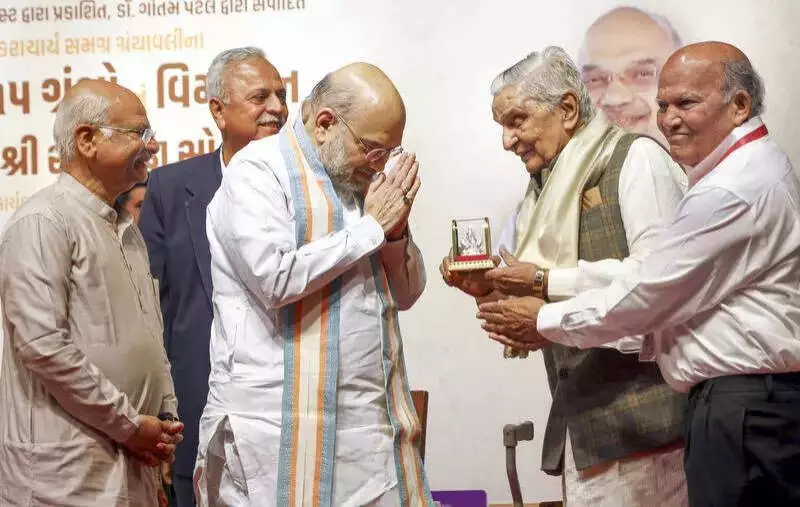
Union Home and Cooperation Minister Amit Shah delivered a powerful speech in Gandhinagar on Thursday. He emphasized the pivotal role of Adi Shankaracharya in forging India's cultural and spiritual identity. Shah spoke at the launch of a Gujarati translation of Shankaracharya's complete works, known as the Granthavali.
Shankaracharya's Monumental Achievements
Amit Shah described the 8th-century scholar as a monumental figure. He stated that very few individuals achieve so much in such a brief lifespan. Shankaracharya traveled extensively across India entirely on foot. Shah likened him to a walking university, spreading knowledge wherever he went.
He established four major monasteries in the four cardinal directions of the country. These institutions were not merely religious centers. They became vital hubs for the preservation and propagation of Vedic knowledge. Under Shankaracharya's guidance, the Vedas were systematically divided among these monasteries for safekeeping.

Defending and Defining Sanatan Dharma
Shah explained that Adi Shankaracharya lived during a period of significant philosophical debate. Various schools of thought, including Buddhism, Jainism, Kapalika, and tantric traditions, were gaining prominence. This environment led to numerous doubts and questions surrounding Sanatan Dharma.
The scholar addressed these challenges head-on. He provided logical and coherent answers to all the emerging questions. Shah noted that Shankaracharya did more than just present ideas. He synthesized them into a cohesive philosophical framework for India.
He made the core essence of Sanatan Dharma accessible to the common person. This included teachings from nature worship to fundamental spiritual principles. Shankaracharya not only discussed the concept of liberation but also charted a practical path to achieve it.
A Modern Resource for the Youth
The newly launched Granthavali comprises fifteen volumes. It contains the complete works of Adi Shankaracharya translated into Gujarati. The publication was handled by the Sastu Sahitya Mudranalay Trust and edited by Gautam Patel.
Minister Shah expressed strong confidence in this publication. He believes it will serve as an invaluable resource for the youth of Gujarat. He urged young people to delve deeply into these texts. Shah asserted that the solutions to many societal questions from that era can be found within these pages.
Engaging with this knowledge, he said, will positively impact their personal lives and professional work. The minister's remarks underscore a continued reverence for classical Indian scholarship and its relevance in contemporary times.