Akbar's Appearance Ignites Fiery Social Media Debate on Historical Accuracy
The legacy of Abu'l-Fath Jalal-ud-din Muhammad Akbar, widely regarded as India's most illustrious Mughal emperor, continues to resonate through the annals of history. His remarkable expansion of territories, advocacy for religious pluralism, and innovative administrative reforms have cemented his status as one of the subcontinent's most exemplary rulers. While "Akbar the Great" remains an eternal figure in historical texts, his legacy has recently leaped into modern discourse through a heated controversy on social media platform X, formerly known as Twitter.
The Spark: A Portrait and a Provocative Claim
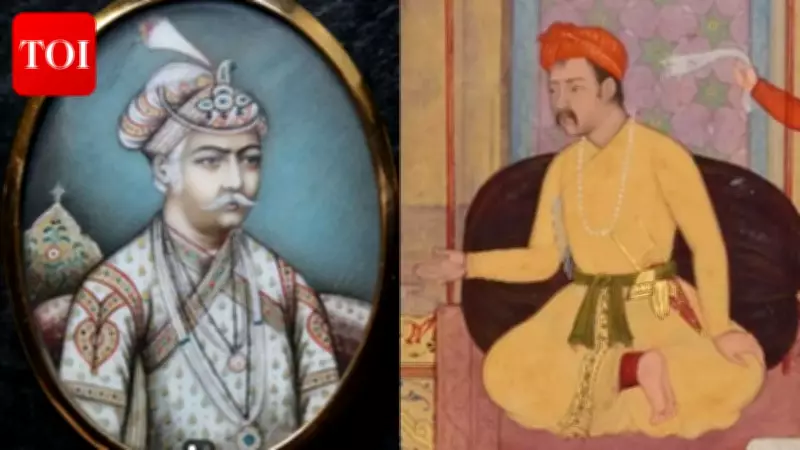
The debate ignited when a user shared a portrait of Akbar to counter assertions made by Indian author Amish Tripathi. Tripathi had reportedly dismissed as "absurd" the notion that modern Indians envision Akbar resembling actor Prithviraj Kapoor, who famously portrayed the emperor in the classic film Mughal-e-Azam. According to the user, Tripathi suggested that to contemporary eyes, Akbar would have appeared Mongolian or Chinese, and that his language was Turkish or Persian rather than Urdu.
The user challenged this view, questioning whether the depicted figure "looked Chinese" and accusing "so-called history narrators" of misrepresenting facts. She argued that Tripathi overlooked key historical details, noting that while Persian was the court language, the spoken language in Akbar's royal household by his generation was closer to modern Brij Bhasha and Haryanvi. Additionally, she pointed out that Akbar's grandfather, Babur, was born merely 700 kilometers from Peshawar—a distance about 30% shorter than that between Delhi and Patna.

In a critical rebuke, she wrote, "The burden of Mr. Tripathi's song was that all history is biased, with an unstated corollary that any made-up version is as valid as an academic's. This is a dangerous slope in any field."
Counterarguments: Evidence of Turco-Mongol Ancestry
However, the original post faced swift correction from another user who highlighted a significant flaw: the "authentic contemporary portrait" cited as evidence was actually painted in 1850, approximately 250 years after Akbar's death. This user presented multiple other portraits of the emperor, asserting that his "Central Asian features are self-evident."
These artworks clearly depict Akbar with characteristics indicative of Central Asian or Turco-Mongol ancestry, such as high cheekbones, almond-shaped eyes, a broad forehead, and a relatively flat facial structure compared to typical South Asian phenotypes. One notable painting, created by artist Hashim around 1614-1615, shows Emperor Jahangir admiring a miniature portrait of his deceased father, Akbar, where the latter exhibits distinct Turco-Mongol traits.
The user concluded with a sharp retort: "Maybe go read a book and learn what real research is next time before arrogantly posturing and making up BS about history first."
Historical Context: Akbar's Origins and Identity
Akbar was born in 1542 at the Umerkot Fort in Rajputana, present-day Sindh, Pakistan, to Emperor Humayun and Hamida Banu Begum. Although he spent his life and reign deeply embedded in South Asian culture, his lineage traces back to Turco-Mongol roots. His grandfather, Babur, hailed from the Fergana Valley in modern-day Uzbekistan and was a descendant of Timur, a Turco-Mongol conqueror, and Genghis Khan, the famed Mongol leader.
Thus, Akbar's ancestry suggests he likely possessed Turco-Mongol physical features, a notion reinforced by the term 'Mughal,' which derives from 'Mongol,' indicating descent from Genghis Khan. By Akbar's reign from 1556 to 1605, the Mughal dynasty had already evolved into a genetic and cultural hybrid, blending Central Asian heritage with Indian influences.

Modern Perspectives: Beyond Racial Categories
Contemporary historians and anthropologists caution against rigid racial classifications, emphasizing that human variation is continuous and not confined to fixed categories. While Akbar may have exhibited Turco-Mongol features, his profound cultural ties and transformative political policies irrevocably anchored him within the South Asian context. This debate underscores the complexities of historical interpretation and the ongoing relevance of Akbar's legacy in shaping discussions on identity, ancestry, and the accurate portrayal of historical figures in the digital age.