Ancient Manuscript Reborn Through Cutting-Edge Technology in Kolkata
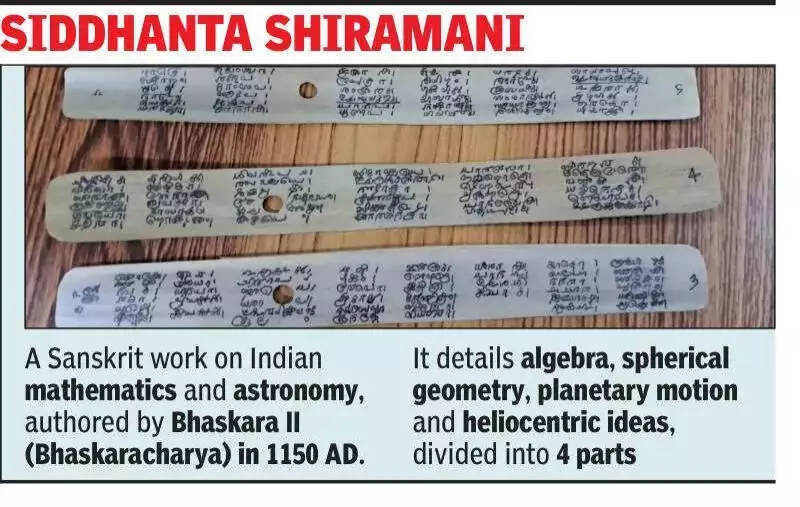
The Asiatic Society celebrated its 243rd Foundation Day with a remarkable display of heritage conservation. Union Culture Minister Gajendra Singh Shekhawat attended the event in Kolkata. The society showcased a reconstructed replica of an ancient palm-leaf manuscript. This project utilized multispectral imaging, artificial intelligence, and 3D printing technologies.
Reviving Bhaskaracharya's Mathematical Masterpiece
The manuscript is a copy of 'Siddhanta Shiramani (Crown of Treatises)'. Bhaskara II, also known as Bhaskaracharya, authored this foundational Sanskrit work in 1150 AD. It covers Indian mathematics and astronomy in great detail. The text explains complex concepts like algebra, spherical geometry, and planetary motion. It even includes early heliocentric ideas. The work is divided into four distinct parts for clarity.
Saumik Bhattacharya and Debasish Sen led the reconstruction effort. They belong to the Vision and Intelligence Systems wing of IIT Kharagpur. The original manuscript was severely degraded and difficult to read. Their team created a precise replica that restores both the content and the physical form of the ancient text. This demonstrates how advanced technology can breathe new life into historical documents.

Anukriti Initiative and Strategic Collaborations
The reconstruction forms part of Anukriti, an initiative by the Asiatic Society. This program aims to conserve India's rich manuscript heritage through scientific methods. During the foundation day event on Thursday, the society signed important memoranda of understanding. These agreements formalize collaborations with IIT Kharagpur, Visva-Bharati University, and CDAC-Kolkata.
The partnerships will focus on several key areas. Heritage science, digitization projects, artificial intelligence applications, and interdisciplinary research are all included. These collaborations promise to enhance preservation efforts across institutions.
Vidhvanika: An AI-Powered Platform for Manuscripts
Two core projects drive this technological preservation work. Anukriti concentrates on the scientific reconstruction of manuscripts and images. Vidhvanika serves as a complementary national platform powered by artificial intelligence.
Vidhvanika enables multiple functions for manuscript study. It allows transcription, transliteration, and translation of ancient texts. The platform also generates metadata and supports search capabilities across collections. Lieutenant Colonel Anant Sinha, administrator of the Asiatic Society, explained the platform's significance.
"By turning scanned manuscript images into machine-readable and searchable knowledge, Vidhvanika will expand global access to India's manuscript heritage," Sinha stated. This technology makes ancient wisdom available to researchers and enthusiasts worldwide.
The event highlighted a successful fusion of tradition and innovation. Ancient knowledge meets modern technology in Kolkata, preserving cultural treasures for future generations.