Ancient Flower Patterns on Pottery May Be Earliest Evidence of Mathematical Thought
A groundbreaking study has uncovered what might be the earliest clues to human mathematical thinking. Researchers examining 8,000-year-old pottery from Mesopotamia have discovered flower patterns that reveal sophisticated concepts of balance, symmetry, and numerical relationships.
Doubling Patterns in Ancient Petal Designs
The study focused on pottery created by the Halafian people who lived in northern Mesopotamia between 6200 BC and 5500 BC. Scientists closely examined 375 pottery fragments collected from 29 different archaeological sites over more than a century of excavations.
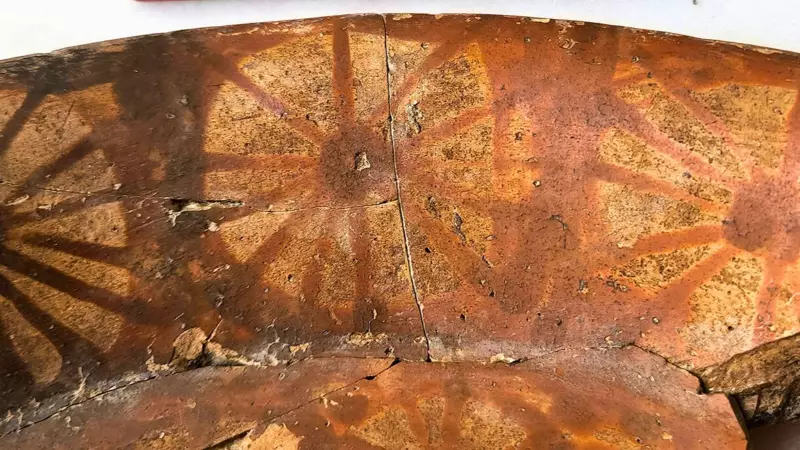
What they found was remarkable. The painted flower designs consistently featured petals in specific numbers: four, eight, 16, 32, and even 64. These numbers follow a clear doubling sequence that cannot be accidental.

The researchers published their findings in December 2025, noting that this pattern strongly suggests deliberate mathematical thinking rather than random decoration.
Evidence of Deliberate Design Choices
Despite the vast distances between excavation sites and the long time span involved, the same doubling patterns kept appearing. Almost every flower design followed this numerical sequence, pointing to intentional design choices shared across the Halafian culture.
According to the study, this represents an early form of mathematical thinking that existed thousands of years before people began writing numbers or equations. The ability to divide a circle evenly into matching parts demonstrates a practical understanding of space and proportion.
Practical Applications in Ancient Village Life
This kind of mathematical thinking likely served practical purposes in everyday Halafian village life. The concepts of division and balance could have been useful for:
- Sharing food resources fairly among community members
- Dividing agricultural land into equal plots
- Organizing community resources and labor
- Creating balanced and symmetrical tools and structures
The researchers emphasize that these number patterns do not match later counting systems developed thousands of years afterward. Instead, they represent a more primitive period of mathematical thinking based on visual patterns rather than symbols or formulas.
Art for Art's Sake in Ancient Times
One particularly interesting discovery concerns the nature of the flowers depicted. The painted flowers are not edible varieties, suggesting their purpose was purely aesthetic rather than practical.
This finding supports the argument that this might represent one of the earliest instances in human history where people viewed nature as a subject for purely artistic appreciation. The Halafian artists seemed to value increased symmetry and design for their own sake.
Scholarly Debate and Significance
Not all scholars completely agree with the mathematical interpretation. Some specialists suggest that while balance is evident in the artwork, it might not demonstrate a deeper mathematical system. They propose that dividing a circle into equal parts might simply have been the easiest way to decorate a round surface.
Despite this debate, the researchers believe their discovery marks a significant milestone in understanding the evolution of human cognition regarding mathematical thinking. The conceptual understanding of division and balance might have paved the way for advanced mathematical concepts that would emerge many centuries later.
This research contributes to growing evidence that early humans expressed mathematical understanding through art and artifacts. Long before written numbers existed, humans were thinking about patterns, symmetry, and structure, leaving their mathematical insights preserved in clay forms for modern researchers to discover.