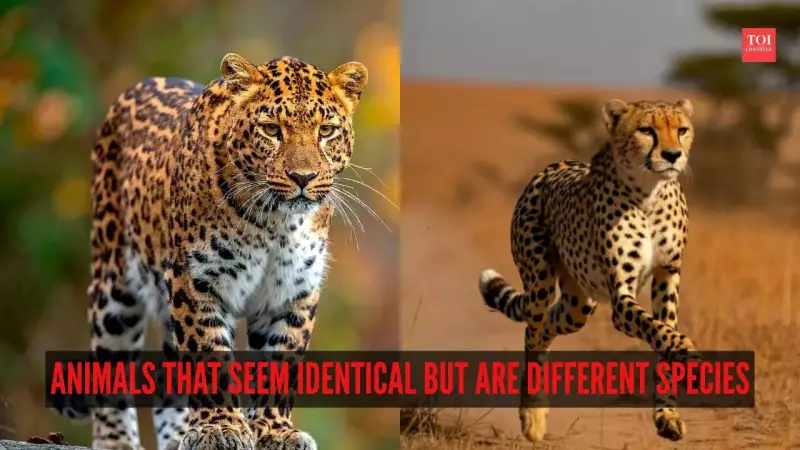
The natural world is a master of disguise, where many creatures share such a striking resemblance that they are often mistaken for one another. At a casual glance, these animals seem identical, leading to the assumption they belong to the same species. However, a closer look at their evolution, habitats, and behaviours reveals they are intrinsically different. Here are eight fascinating pairs of animals that appear almost exactly alike but are, in fact, distinct species.
From Meadows to Marshes: Terrestrial Confusions
Rabbits and hares are a classic example of mistaken identity. While both are lagomorphs, hares are generally larger and sport distinctive black-tipped ears. A key difference lies in their birth: rabbits are born blind and hairless, requiring the safety of underground burrows. Hares, in contrast, enter the world fully furred, sighted, and are adapted to life in open upland areas.
In the reptile world, crocodiles and alligators are often confused. They belong to separate biological families. The most noticeable distinction is the shape of their snout: crocodiles have a narrow, V-shaped snout and can thrive in both saltwater and freshwater habitats. Alligators possess a broader, U-shaped snout and primarily inhabit freshwater environments.

The spotted big cats, leopards and cheetahs, also cause confusion. A cheetah's coat features solid black spots and unique black "tear lines" running from its eyes to its mouth. Leopards have more complex rosette-shaped spots. Physically, the cheetah is built for speed, while the leopard is more robust and an excellent climber.
Sky, Sea, and Swamp: More Look-Alikes
In the avian family, crows and ravens are both highly intelligent corvids but are different species. Ravens are notably larger, have a thicker beak, a wedge-shaped tail, and produce a deeper, croaking call. Crows are smaller, have a fan-shaped tail, and are more social, frequently forming large flocks near human settlements.
The winged insects, butterflies and moths, differ in their daily routines and physiology. Butterflies are diurnal, possess thin antennae with clubbed tips, and typically rest with their wings closed vertically. Moths are mostly nocturnal, have feathery or filamentous antennae, and rest with their wings spread out horizontally.
Marine mammals seals and sea lions are both pinnipeds but have clear distinctions. Sea lions have small external ear flaps and powerful front flippers that allow them to "walk" on land. Seals lack external ears and move on shore by wriggling on their bellies. Sea lions are also more vocal and socially gregarious.
Amphibians and Cetaceans: Subtle Distinctions
Frogs and toads are amphibians from different families. Frogs usually have smooth, moist skin, long hind legs built for leaping and swimming, and a more aquatic lifestyle. Toads tend to have drier, bumpy skin, shorter legs suited for walking or short hops, and are often found further from water.
Finally, in the ocean, dolphins and porpoises are both cetaceans but differ significantly. Dolphins typically have elongated beaks, curved dorsal fins, and are known for their high intelligence, sociability, and complex vocalisations. Porpoises are generally smaller and shyer, with blunt snouts and triangular dorsal fins.
Observing these differences between seemingly identical animals is more than an educational exercise; it fosters a deeper appreciation for nature's intricate complexity. It reminds us that in the rich tapestry of life, what appears alike on the surface is often wonderfully unique upon closer inspection.