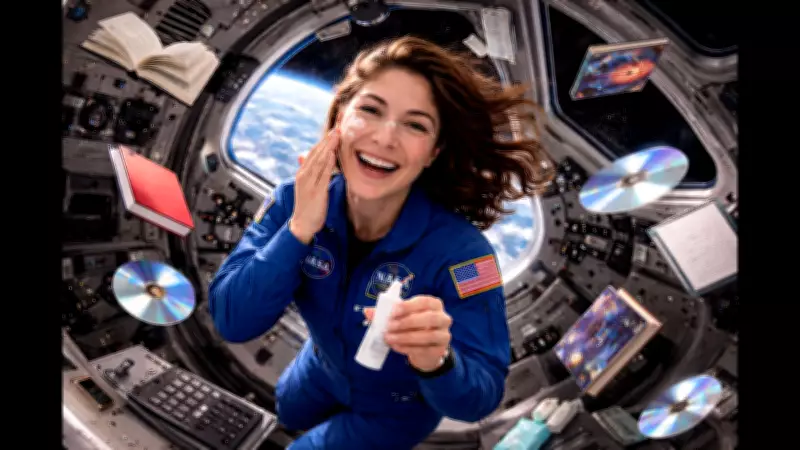
Skincare Goes Interstellar: Astronaut's Request from Space Captivates Earth
In a moment that feels quietly symbolic for human history, skincare has literally reached the stars. Actress and entrepreneur Jessica Alba received an extraordinary call from outer space when astronaut Christina Koch requested her company's hand lotion while aboard a spacecraft. This incident, though seemingly small on the surface, reveals expansive insights into our evolving relationship with space exploration.
The Human Touch in the Cosmos
When Alba teared up upon learning about Koch's request, it underscored how beauty and personal care have transcended Earth's boundaries. We often imagine space as a realm of extremes—characterized by technological precision, existential solitude, and survival stripped to bare essentials like oxygen, water, and fuel. Yet, within this carefully calculated ecosystem, a simple tube of hand lotion found its place, challenging our perceptions.
It's easy to dismiss skincare in space as trivial, but this isn't the first time astronauts have connected with humanity in familiar ways. For decades, spacefarers have carried fragments of Earth beyond functional items, including music, photographs, and personal mementos. A notable example is Canadian astronaut Chris Hadfield, who in 2013 recorded the first music video in space by covering David Bowie's 'Space Oddity' aboard the International Space Station, creating a viral sensation that bridged cultural gaps.

More Than Just Moisturizer: The Science and Sentiment
Space, for all its grandeur, is an inhospitable environment for the human body. Microgravity affects circulation, weakens muscles, and causes bone density loss. Even the skin—our primary interface with the world—becomes dry, sensitive, and fragile. In such conditions, skincare isn't an indulgence; it's essential maintenance for health and comfort.
However, Koch's request for Alba's lotion goes beyond practicality. It represents something less quantifiable: a familiar scent, texture, and the small, repetitive act of self-care that can anchor an astronaut amidst the isolation of space. These routines echo daily life on Earth, providing continuity and a piece of home, even from the far side of the moon. This emotional connection is fundamentally human, highlighting how we adapt and recreate fragments of home wherever we go.
A Broader Shift in Space Exploration Narratives
This incident reflects a broader shift in how we understand space exploration. The early decades were defined by competition and conquest, with flags planted and milestones claimed. Today, the narrative is softening as we focus not just on reaching farther but on living in space, however temporarily. Living includes the small things—comfort, routine, and care—that make extraterrestrial missions more sustainable and humane.
For Alba, whose company, The Honest Company, was built on safe, thoughtful products rooted in personal experience, this moment carried emotional gravity. It wasn't merely a marketing milestone but a validation of her vision: products born from domestic life, like a mother's concern or a household need, finding relevance in the most extreme frontier imaginable.
Historically, we can draw parallels to other human expansions—such as the first books carried across oceans or seeds planted in foreign soil—each marking adaptation and the instinct to recreate home. This story resonates because it distills that same instinct into a simple tube, reminding us that even in space, our humanity travels with us.