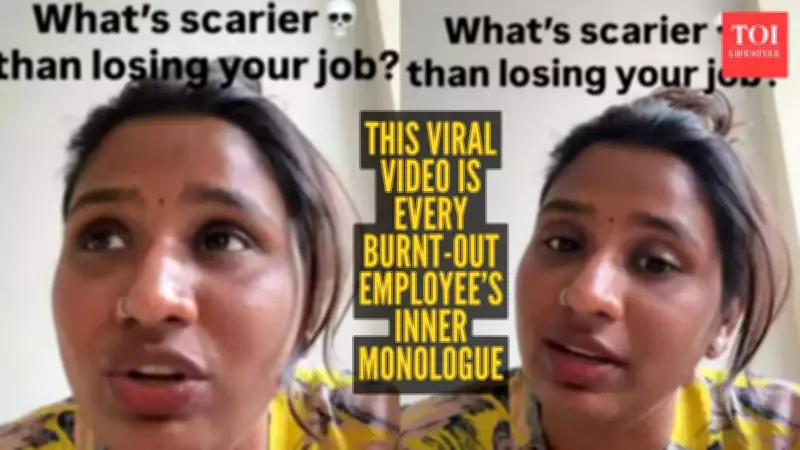
Woman's Viral Video Sparks National Conversation About Workplace Burnout
A 24-year-old woman has ignited a massive online conversation after posting a painfully honest video about the emotional toll of staying employed - something most working people feel but rarely express openly. The video, which has resonated with thousands across social media platforms, cuts to the core of modern workplace struggles that extend far beyond financial concerns.
The Raw Truth About Employment's Hidden Costs
The woman, identified as Swathi (@lifeofswa), opens her powerful clip with a statement that immediately captures attention: "You know what's scarier than losing a job? When you end up looking like this." She accompanies the video with a caption that delves even deeper into the psychological impact of sustained employment, suggesting that losing sleep, losing peace, and losing confidence often hurts more profoundly than losing a paycheck.
In her emotional presentation, Swathi points to how workplace stress has gradually manifested physically on her face - through tired eyes, diminished energy levels, and a version of herself she barely recognizes anymore. According to her perspective, the genuine fear isn't unemployment itself, but rather watching oneself gradually fade away while continuing to work day after day.

"You're earning money, you're showing up every day, but at the same time you're giving away your happiness," she explains with striking clarity. She elaborates that work pressure has transformed life into a constant internal conflict - not between success and failure as commonly portrayed, but between basic survival and maintaining one's sanity.
Societal Expectations Versus Personal Well-being
Swathi adds that contemporary society quietly expects individuals to prioritize productivity over personal peace, creating an environment where endurance receives praise while rest often generates feelings of guilt. Her message remains blunt and uncompromising: most people don't remain in jobs because they love them passionately. They stay because responsibilities don't pause and bills remain indifferent to burnout.
She describes how people continue this cycle - logging in daily, meeting relentless deadlines, smiling during meetings, while internally mourning the confident, energetic person they once were. Swathi frames this not as personal weakness but as a reality of modern existence: a systemic issue where perseverance receives celebration while recovery feels like transgression.
"If you're choosing your job even when it's costing you peace, you're not alone," she offers as both comfort and indictment. "You're just surviving in a world where mental health feels optional."
Internet Reacts With Empathy, Arguments, and Uncomfortable Truths
The video has clearly struck a powerful nerve across digital platforms. Numerous users have flooded the comments section sharing their own exhaustion and burnout narratives, expressing gratitude for feeling seen and understood for the first time in recent memory.
However, not all responses have been uniformly supportive. The divided reactions have actually reinforced Swathi's central argument - that for many individuals, this isn't a simple choice between happiness and work, but rather a complex decision between stability and uncertainty.
The spectrum of responses includes:
- Many sharing personal burnout experiences and emotional exhaustion stories
- One user countering that the real fear involves having a family to feed without reliable income
- Another pointing out that people endure this stress often for "bare minimum pay"
- Some advising better prioritization of self-care practices
- A few suggesting bluntly that if a job causes significant harm, one should simply leave
This viral phenomenon continues spreading not because it presents dramatic exaggeration, but precisely because it reflects an uncomfortably familiar reality for countless working professionals. The conversation has expanded beyond individual experience to question broader workplace cultures and societal expectations around employment, productivity, and personal well-being in contemporary life.