

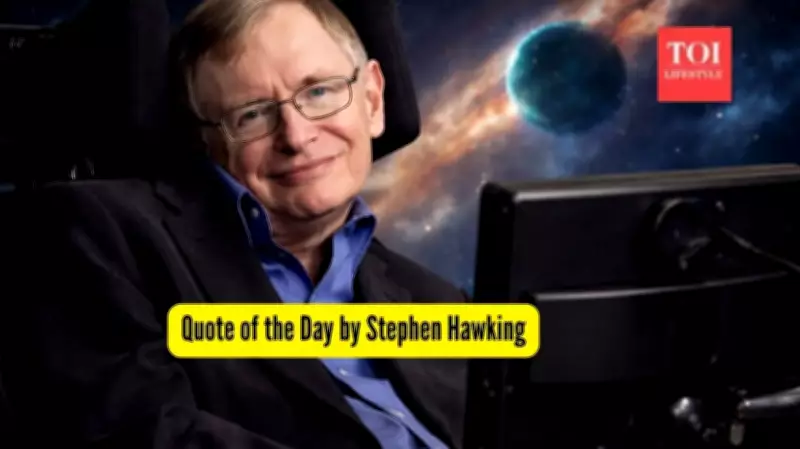
Stephen Hawking: A Titan of Science and Symbol of Human Fortitude
Stephen Hawking stands as one of the most pivotal scientific minds of the 20th century, celebrated for his transformative contributions to cosmology, his unwavering courage in confronting a debilitating illness, and his unique talent for demystifying complex scientific concepts for a global audience. His narrative transcends mere academic achievement, embodying the profound resilience, curiosity, and strength inherent in the human spirit.
Early Life and Academic Foundations
Born on January 8, 1942, in Oxford, Stephen William Hawking exhibited intelligence and curiosity from a young age, though he was not initially regarded as an exceptional student. He pursued physics at the University of Oxford before advancing to graduate studies in cosmology at the University of Cambridge, where he began to delve into the mysteries of the universe as a whole.
Triumph Over Adversity: The ALS Diagnosis
At the age of 21, Hawking received a devastating diagnosis of Amyotrophic Lateral Sclerosis (ALS), a rare neurological condition that progressively paralyzes the body. Initially given only a few years to live, he defied medical expectations with remarkable determination. As the disease advanced, he lost the ability to walk, write, and speak, yet through innovative assistive technologies, including a speech-generating device, he continued to communicate his groundbreaking ideas to the world.

Revolutionary Scientific Contributions
Hawking's scientific legacy is anchored in his pioneering work on black holes and the origins of the universe. In collaboration with mathematician Roger Penrose, he applied the principles of General Relativity to demonstrate that the universe originated from a singularity—a point of infinite density—thereby providing robust support for the Big Bang Theory and reshaping our understanding of cosmic beginnings.
One of his most renowned discoveries is Hawking Radiation, which challenged the long-held belief that black holes are entirely impervious to emission. Hawking proposed that due to quantum effects near their event horizons, black holes can emit radiation, gradually losing energy and potentially evaporating over time. This breakthrough was instrumental in bridging the gap between quantum mechanics and general relativity, two foundational yet often disparate fields of physics.
Championing Science Communication
Beyond his research, Hawking excelled as a science communicator. His 1988 book, A Brief History of Time, became an international bestseller, captivating millions by elucidating intricate topics such as black holes, the nature of time, and the universe's inception. The book's enduring popularity sparked widespread public interest in science, cementing Hawking's role as a cultural icon.
Personal Resilience and Philosophical Insights
Despite facing severe health challenges and personal upheavals, Hawking maintained an optimistic outlook, often employing humor to navigate difficulties. He famously remarked that life may present obstacles, but there is always something one can excel at, inspiring individuals worldwide, particularly those grappling with adversity.
In his later years, he pondered profound questions about time, the existence of multiverses, and humanity's future, advocating for cautious consideration of issues like climate change, artificial intelligence, and overpopulation. He also promoted space exploration as a potential avenue for long-term human survival.
Legacy and Final Reflections
Stephen Hawking passed away on March 14, 2018, in Cambridge, England, leaving behind an indelible legacy as one of history's greatest scientific intellects. His life exemplifies that human potential is not constrained by physical limitations but is fueled by curiosity, determination, and a relentless pursuit of knowledge.

Iconic Quote: A Humble Yet Awe-Inspiring Perspective
One of Hawking's most iconic statements encapsulates his worldview: “We are just an advanced breed of monkeys on a minor planet of a very average star. But we can understand the universe. That makes us something very special.” This quote begins by humbling humanity, emphasizing our evolutionary origins and the cosmic insignificance of Earth. However, it swiftly transitions to awe, highlighting our unique capacity to comprehend the universe through disciplines like physics and astronomy. This duality encourages humility while celebrating the extraordinary power of human intellect, reminding us that our ability to explore and understand the cosmos is what truly sets us apart.





