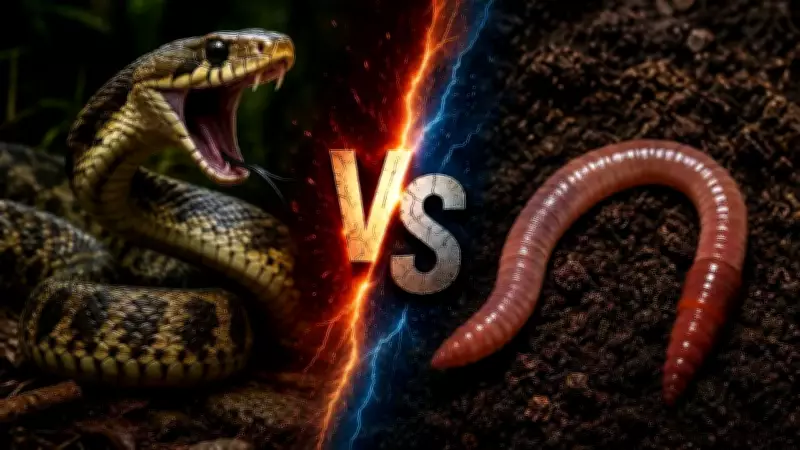
At a casual glance, a snake and an earthworm may appear quite similar. Their bodies are long, slender, and completely devoid of limbs, making the comparison easy to draw. However, this similarity is largely superficial. Beneath the surface, these creatures belong to entirely different biological groups and have evolved distinct ways of surviving. Snakes are reptiles adapted for movement, hunting, and life in diverse landscapes. Earthworms, in contrast, spend most of their existence underground, processing organic matter and contributing to healthy soil. Their anatomy, feeding habits, and ecological functions reflect separate evolutionary journeys that share little beyond a common body shape.
Snake vs Earthworm: Anatomy and Lifestyle Comparison
| Parameter | Snake | Earthworm |
|---|---|---|
| Animal group | Reptile | Annelid worm |
| Backbone | Present | Absent |
| Body covering | Dry scales | Moist skin |
| Breathing | Through lungs | Through skin |
| Diet | Carnivorous | Feeds on decaying organic matter |
| Habitat | Forests, grasslands, deserts, wetlands | Soil and underground burrows |
| Movement | Slithers using muscles and scales | Moves by contracting body segments |
| Size | Can reach several metres | Usually a few centimetres to a few dozen centimetres |
| Reproduction | Separate males and females | Hermaphroditic |
| Ecological role | Predator | Soil recycler |
Snake vs Earthworm: Comparison of Form, Function, and Lifestyle
Animal Group
Snakes are part of the reptile class, alongside lizards, turtles, and crocodilians. They are vertebrates with complex organ systems and specialized adaptations for terrestrial life. Earthworms belong to a completely different category known as annelids, a group of segmented invertebrates whose bodies are built for life beneath the soil.
Backbone
The internal structure of a snake is supported by a well-developed skeleton. Numerous vertebrae run along the length of its body, providing both strength and flexibility. Earthworms lack bones altogether. Instead, their bodies rely on fluid-filled compartments and muscular walls that allow them to maintain shape while moving through narrow underground spaces.

Body Covering
A snake's body is protected by overlapping scales that shield it from injury and reduce moisture loss. Earthworms have no such covering. Their skin remains soft and damp, a condition necessary for several life processes and must be maintained for the animal to survive.
Breathing
Air enters a snake's body through the nostrils before reaching the lungs, where oxygen is absorbed. Earthworms use a far simpler method: oxygen passes through their moist skin and diffuses into blood vessels beneath the surface. Dry skin can become a serious problem for them.
Diet
Most snake species are predators that capture and consume other animals. Their prey includes mammals, birds, amphibians, fish, or insects, depending on the species and habitat. Earthworms feed on decaying leaves, plant fragments, and other organic material found in the soil, helping convert waste into nutrients.
Habitat
Snakes have adapted to an impressive variety of environments, from dense rainforests and open grasslands to deserts and marshes. Earthworms are far more restricted in where they can thrive. They favor moist soil where conditions remain cool enough to prevent their skin from drying out.
Movement
Despite lacking limbs, snakes move with remarkable efficiency. Waves of muscular contractions work with specialized belly scales to push the body forward. Earthworms travel using a different mechanism, repeatedly shortening and extending segments, while tiny bristles help anchor parts of the body within the soil.
Size
The size difference between these animals is substantial. Some snakes can exceed several metres in length, making them among the largest reptiles in their habitats. Earthworms are generally much smaller, with most species measuring only a fraction of the length commonly reached by snakes.

Reproduction
Snakes reproduce through mating between male and female individuals. Depending on the species, reproduction may involve laying eggs or giving birth to live young. Earthworms possess both male and female reproductive organs, although they usually exchange genetic material with another worm before producing cocoons containing offspring.
Ecological Role
Within ecosystems, snakes often occupy the role of predator, helping keep populations of smaller animals in balance. Earthworms contribute differently. Their feeding and burrowing activities improve soil quality, enhance drainage, and assist in the breakdown of organic material, making nutrients available to plants.
Why Snakes and Earthworms Are Far More Different Than They Appear
The most obvious similarity between snakes and earthworms is their elongated, limbless form. Both rely on muscular movement rather than legs and can travel through confined spaces with relative ease. Beyond these shared traits, however, they differ in nearly every major aspect of biology. One is a vertebrate reptile adapted for hunting, while the other is a soil-dwelling invertebrate that plays a key role in decomposition. Their comparison demonstrates how outward appearance can sometimes hide profound differences in structure, behavior, and ecological purpose.
About the Author: The TOI Lifestyle Desk is a dynamic team of dedicated journalists who, with unwavering passion and commitment, sift through the pulse of the nation to curate a vibrant tapestry of lifestyle news for The Times of India readers. At the TOI Lifestyle Desk, we go beyond the obvious, delving into the extraordinary. Consider us your lifestyle companion, providing a daily dose of inspiration and information. Whether you're seeking the latest fashion trends, travel escapades, culinary delights, or wellness tips, the TOI Lifestyle Desk is your one-stop destination for an enriching lifestyle experience.