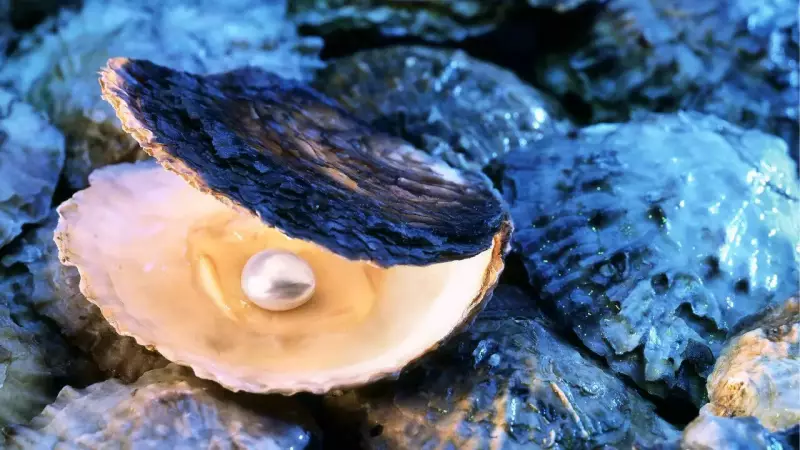
For centuries, pearls have been symbols of elegance and purity. But their origin story is far from serene. It begins not with beauty, but with a problem. A tiny, unwelcome particle—a parasite, a grain of sand, or debris—finds its way inside an oyster's shell. The mollusc cannot expel this irritant, nor can it flee. Its remarkable response, a quiet act of biological patience, is what ultimately creates one of nature's most coveted treasures.
The Deliberate Biological Process of Pearl Creation
Contrary to popular belief, pearl formation is not a chaotic accident. It is a highly controlled biological defence mechanism. When an irritant lodges itself, the oyster does not react aggressively. Instead, as explained in a peer-reviewed study published in the journal Science Advances, it initiates a slow and deliberate process. The oyster secretes a smooth substance to coat the intruder, reducing discomfort. This action is repeated countless times.
Scientists studying molluscs have revealed that oysters follow a tightly regulated procedure. They meticulously control the combination of minerals and proteins to form nacre, also known as mother-of-pearl. This ensures layers build up in an organised, structured manner rather than in a random, chaotic fashion. This innate biological control is the key to transforming a source of irritation into a stable, beautiful object.

Layer by Layer: The Growth and Character of a Pearl
Once the irritant is isolated, the oyster's mantle tissue takes charge. It begins depositing thin, successive layers of nacre, which is primarily composed of calcium carbonate and protein. Each layer settles gently over the previous one. This process is never rushed; it is a testament to gradual, persistent effort.
Pearl growth occurs in uneven stages. External factors like changes in water temperature, food availability, or environmental stress can slow down or alter the deposition of nacre. These natural interruptions become permanently etched into the pearl's structure. This is why, upon close examination, no pearl is perfectly uniform. Each one bears unique marks of its journey, making it a natural chronicle of its environment.
What Determines a Pearl's Colour, Quality, and Value
The mesmerising colour of a pearl does not merely sit on its surface; it emanates from within. Different oyster species produce varying shades due to differences in their nacre chemistry. Some yield pale, silvery pearls, while others create darker, golden, or peacock tones. The thickness of the nacre layers and how light interacts with them also play a crucial role. Even trace minerals in the surrounding water can influence subtle undertones, explaining why two pearls from the same region can look distinct.
The oyster's environment—salinity, temperature, and diet—quietly shapes the pearl's development. These factors accumulate over years, defining its final lustre, surface texture, and visual identity. This is why pearls from different waters carry unique signatures.
In the modern pearl industry, most gems are cultured. Here, humans initiate the process by surgically inserting a nucleus into the oyster. However, after this intervention, the farmer's control ends. The oyster treats this implanted nucleus exactly like a natural irritant and begins its innate layering process. While farmers can optimise water quality and oyster health, they cannot dictate the final outcome. The shape, colour, and lustre remain solely dependent on the oyster's biological response and its environment.
Pearl value is often misunderstood. Size alone is a poor indicator of quality. More important factors include the thickness of the nacre, a smooth surface that reflects light brilliantly, and a deep lustre indicating healthy, consistent layering. Interestingly, some irregular or baroque pearls are highly prized precisely because their unique shapes showcase visible evidence of natural growth, where character outweighs perfect symmetry.

The True Meaning of a Pearl: Survival, Not Decoration
Ultimately, an oyster does not create a pearl for adornment. It creates it to survive. What begins as an irritation is neutralised through patience and repetition. Layer by layer, the source of discomfort is sealed away through adaptation, not through fight or flight. Every pearl is, therefore, a quiet record of resilience hidden within its shimmering layers. Understanding this intricate process transforms a pearl from a mere decorative object into powerful evidence of how life responds when escape is impossible, and the only option is gentle, persistent adjustment.