

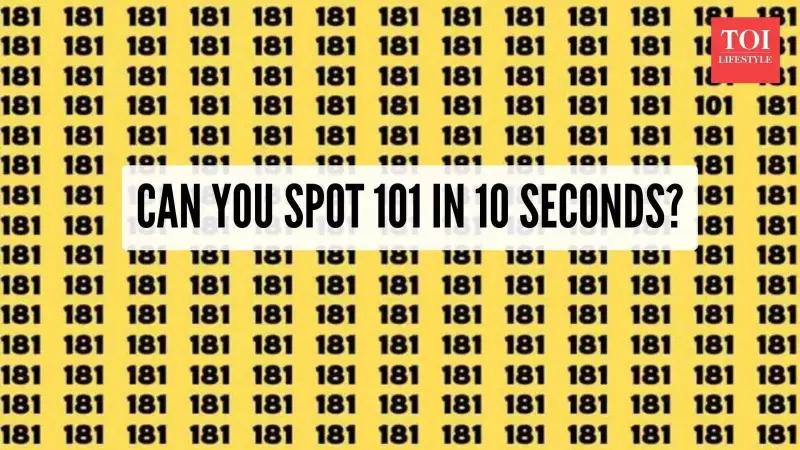
Do you love a quick mental workout that pushes your focus and patience to the limit? A new optical illusion making the rounds online promises exactly that. At first glance, the task seems deceptively simple, but once the clock starts ticking, most people discover it's a true test of their observation skills.
The 10-Second Brain Challenge
The challenge presents a grid filled with the number 181. Every row and every column appears identical, creating a hypnotic pattern. However, there's a clever twist: one single number in the entire grid is different. That number is 101. Your mission is to locate this odd one out, but you have only 10 seconds to do it. Some even more intense versions of the puzzle reduce the time limit to a mere 3 seconds.
So, are you ready? Take a deep breath, start your mental timer, and scan the grid carefully. Move row by row without rushing. Have you spotted the number 101 yet? If you're still searching, you're in good company. Many find this puzzle trickier than it looks.

Why Your Brain Gets Tricked
Optical illusions like this one work because the human brain is wired to recognize patterns efficiently. When it sees the same number—181—repeated over and over, it quickly assumes uniformity. Your eyes may scan the image, but your brain, seeking to save energy, fills in the expected information and glosses over minor details. This is why the 101 can remain hidden in plain sight, even when you're looking directly at it.
These puzzles are often linked to sharp observation skills and meticulous attention to detail. Individuals who spot the odd number quickly typically excel at maintaining focus under pressure. They can filter out the distracting pattern and zero in on the anomaly. It's crucial to note that this doesn't imply others are less intelligent; it simply highlights the fascinatingly different ways our brains process visual data.
What Your Result Means & A Pro Tip
If you managed to find the 101 within the 10-second window, give yourself a pat on the back. It indicates your visual scanning abilities are quite sharp. Spotting it in the ultra-fast 3-second timeframe is even more impressive, suggesting rapid cognitive processing and powerful concentration.
Still haven't found it? Here's a useful strategy: instead of reading each full number, focus solely on the middle digit. In 181, the middle digit is 8. In 101, the middle digit is 0. This simple shift in your search technique can make the hidden number pop out almost instantly.
Beyond being a fun diversion, optical illusion IQ tests serve as excellent brain exercises. Regularly engaging with such puzzles can help improve your attention span, boost visual memory, and enhance problem-solving skills. They offer a perfect, stress-free mental break from daily routines, providing both entertainment and cognitive benefits.
Now, go ahead and take one final look. Scan each row slowly and deliberately. Once you finally spot the elusive 101, you'll likely be amazed at how you missed it before. That moment of surprise is all part of the magic and appeal of a great optical illusion.






