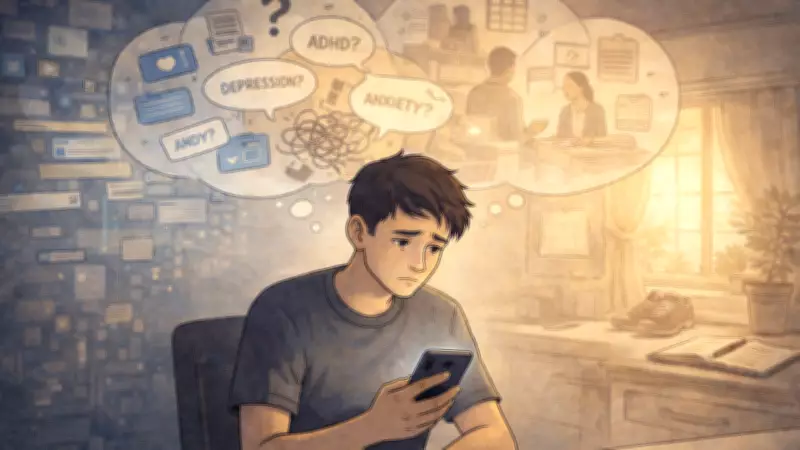
The Digital Diagnosis Dilemma: When Screens Become Symptom Checkers
On a smartphone screen, symptoms align with deceptive neatness. Restlessness, persistent fatigue, disrupted sleep patterns, and a nagging sense of worry transform a difficult week into what appears to be a clear diagnosis. For countless individuals, this journey begins subtly: a single sleepless night, mounting workplace stress, or unexpected trouble concentrating. What follows is often a quick online search.
With internet access now nearly universal across India, people increasingly turn to search engines and social media platforms at the first hint of psychological discomfort, frequently long before considering a clinic visit or professional counsellor. Everyday emotional struggles are filtered through symptom checklists and mental health posts promising immediate clarity. The convenience proves irresistible. Answers materialize instantly, bypassing appointments and difficult conversations. Yet as screens increasingly mediate how distress is interpreted, the boundary between genuine self-awareness and premature self-diagnosis grows dangerously blurred.
The Prevalence of Self-Identified Conditions
Anxiety and depression rank as the most commonly self-identified mental health conditions, but a growing trend sees individuals diagnosing themselves as neurodivergent based solely on online content. Psychologists emphasize a critical problem: many mental health symptoms overlap not only across different disorders but also with various physical illnesses. Low energy levels, poor concentration, or changes in appetite can point in multiple directions. Without proper clinical training, naming a condition becomes speculative guesswork, and the consequences of error—from inappropriate self-treatment to dangerously delayed professional care—can be severe.

As self-diagnosis becomes more widespread, it raises profound questions about trust in healthcare systems, equitable access to services, and the underlying reasons compelling so many to seek answers about their own minds from the internet rather than professionals.
The Social Media Mental Health Landscape
Mental health content now occupies a vast and influential corner of social media, particularly on visually-driven platforms like Instagram. However, most of this content is not created by trained mental health professionals. A significant proportion of mental health-related videos circulating online contain inaccurate or misleading information. This reality creates tension with the authoritative tone these videos often command among viewers.
Social media platforms do not merely reflect public opinion; they actively shape it. This dynamic becomes especially troubling in mental health contexts, where misinformation has been shown to spread faster and reach broader audiences than verified, factual content. Short-form videos, stripped of necessary nuance and engineered for virality, can reduce complex psychological conditions to oversimplified "symptom checklists," encouraging viewers to see their own experiences in what they watch.
Vulnerability in the Digital Space
While anyone can be misled online, certain user groups face higher vulnerability. Individuals scrolling passively, without actively seeking specific information, are more likely to absorb false or incomplete claims than those approaching content with defined questions or healthy skepticism. This passivity matters greatly because much of what users encounter on social media is no longer a matter of personal choice. Sophisticated personalization algorithms determine what appears on feeds, quietly narrowing the informational landscape a person sees.
In practice, this means users may repeatedly encounter similar mental health narratives—often sensationalized, oversimplified, or incorrect—without realizing how curated their digital experience has become. Over time, repetition lends these narratives unwarranted credibility. When a particular diagnosis or label appears frequently enough, it can start to feel self-evident, even in the complete absence of professional evaluation.

For mental health, the implications are serious and far-reaching. Accepting misinformation uncritically can lead to incorrect self-diagnosis, inappropriate self-treatment methods, or dangerous delays in seeking medical care. In a country like India, where mental healthcare infrastructure is already stretched thin and social stigma remains a significant barrier, the internet often fills a critical vacuum. But when unverified voices and algorithm-driven amplification dominate that space, the cost of confusion is ultimately borne by users trying, in good faith, to understand their own psychological experiences.
What Self-Diagnosis Leaves Out: The Clinical Perspective
One of the most significant limitations of self-diagnosing mental health conditions lies in what it systematically excludes. Online checklists and explanatory videos rarely account for differential diagnosis or comorbidity—the clinical processes of distinguishing between conditions with similar presentations or recognizing when multiple conditions coexist. In reality, mental health concerns seldom appear in neat isolation. A professional diagnosis is often layered, shaped by how one difficulty triggers or intensifies another.
"Self-diagnosis can never be truly helpful. At best, you can only identify that you are not functioning well or that your daily life is getting hampered, and then seek professional help. When you start searching your symptoms on Google or ChatGPT, that is when it begins to become problematic," explained Sreerupa, a practicing behavioural therapist.
Consider panic disorder as an example. Persistent panic attacks can erode a person’s sense of control and stability, potentially giving way to secondary hopelessness or depression. Treating one condition without recognizing the other can significantly blunt recovery efforts. This is where rigorous clinical training proves indispensable. Mental health professionals are trained to rule out overlapping conditions and to factor in comprehensive medical history, social environment, cultural background, and life circumstances—elements largely absent from online self-assessments. Without this broader contextual lens, treatment plans risk addressing the wrong problem, or only a fragment of it.
The Challenge of Overlapping Symptoms
Misdiagnosis becomes especially likely when disorders share visible behavioral traits. Borderline personality disorder and bipolar disorder, for instance, can both involve impulsive behavior, intense mood swings, irritability, and suicidal ideation. ADHD and borderline personality disorder, though fundamentally different in origin, may both present as emotional sensitivity, impulsivity, and strained interpersonal relationships. Similarly, schizoid personality disorder and autism spectrum conditions can overlap in social withdrawal and limited emotional expression, despite having distinct underlying mechanisms.
Anxiety and depression further complicate clinical pictures because many of their core symptoms—such as low energy, poor concentration, sleep disruption, irritability, and appetite changes—are common across a wide spectrum of mental health conditions. Trauma, too, has become an expansive umbrella term online, used to explain a growing list of emotional and behavioral experiences, often without regard for established clinical thresholds or individual context.
What frequently gets lost in self-diagnosis is proportion and clinical significance. Most people will experience anxiety, low mood, restlessness, or concentration difficulties at various life stages. These experiences alone do not constitute a disorder. Clinicians evaluate how long symptoms persist, their frequency and intensity, how many appear concurrently, and, crucially, whether they substantially interfere with daily functioning across multiple life domains.
Mental health conditions are inherently complex, shaped by intricate interactions between biology, environment, and personal experience. Reducing them to labels drawn from internet searches can flatten this essential complexity, leaving critical questions unasked and unanswered. In attempting to name their distress, individuals may miss the fuller clinical picture—one that requires specialized training, nuanced context, and careful professional judgment to perceive clearly.
Understanding the Drivers Behind Self-Diagnosis
The growing tendency toward self-diagnosing mental health conditions is driven by several overlapping societal and technological factors rather than a single cause. Key prevalent drivers include:
- The overwhelming volume of mental health content online: Social media platforms are saturated with mental health discussions that can severely mislead individuals and push them toward self-diagnosis. Available content, especially short-form formats, tends to oversimplify complex disorders. These posts often reduce serious clinical diagnoses to handfuls of generic symptoms, making it easier for users to see themselves reflected, even when completely inaccurate.
- Persistent stigma and hesitation around seeking professional help: Despite greater public awareness and open conversations about mental health, significant stigma remains entrenched. Many individuals fear judgment from family, friends, employers, or even healthcare professionals, leading them to seek answers privately through online channels.
- Limited access to affordable professional care: In India, access to quality mental healthcare remains unevenly distributed and often prohibitively expensive. Long waiting periods for appointments, language barriers, and a critical shortage of trained professionals collectively push people toward quicker, cheaper online alternatives.
- The human need for reassurance and rapid explanations: For those grappling with ongoing stress, anxiety, sleep problems, or diminished self-esteem, uncertainty itself becomes distressing. Online self-diagnosis offers an immediate, albeit potentially false, sense of clarity and control.
- Feeling unheard or misunderstood by existing systems: Some individuals turn to online self-diagnosis after negative experiences with healthcare professionals or personal relationships where their struggles were minimized, dismissed, or ignored.
For a generation accustomed to immediacy—quick searches, instant responses, and constant digital connectivity—turning to a screen often feels easier than sitting with psychological uncertainty or discomfort. Technology has also altered social behavior in subtler ways. As more human interactions migrate online, social isolation has become normalized, even comfortable. Information, reassurance, and conversation are all accessible without leaving one's room.
"Easy access to the internet is one of the most significant features of modern life. People of this generation are highly dependent on instant gratification, which has made many of them lazier. Moreover, technology has made us more isolated, and we have gradually become accustomed to this isolation because we can access information or communicate with people while simply lying in bed. So breaking this barrier and approaching a therapist to address the actual issues requires a great deal of courage," Sreerupa observed.
Young Minds in Digital Spaces: Screen Time as Education
Screen time now frames much of contemporary childhood and adolescence. According to the American Academy of Child and Adolescent Psychiatry, children aged 8 to 12 spend 4 to 6 hours daily in front of screens. For teenagers, this figure rises to nearly nine hours. These statistics matter profoundly because they describe not merely entertainment habits, but the primary spaces where young people are learning to understand themselves and interpret their emotions.
Teenagers and young adults today are fundamentally growing up online. Smartphones and social media platforms are where they encounter new ideas, form opinions, and search for vocabulary to describe their inner experiences. Mental health, once discussed quietly or avoided entirely, has become a visible and frequent topic in these digital ecosystems. Videos, posts, and discussion threads about anxiety, depression, ADHD, or trauma are shared widely, often framed as relatable and reassuring.
"Breaking the barrier and actually reaching out for help is a big deal. But at the same time a lot of online content, especially videos that show symptoms of mental disorders, can have a negative impact. As human beings, we are naturally biased, especially when we are not trained in psychology. Sometimes we see what we want to see," Sreerupa noted.
For many young users, this content fills a genuine gap. Conversations about mental health remain limited within many families, schools, and colleges, and access to professional support is uneven. The internet steps in as a readily available, always-on guide. However, this ease of access simultaneously raises serious concerns. Much of what circulates online is simplified, anecdotal, or driven by engagement metrics rather than clinical accuracy.
When hours of daily screen time double as hours of informal mental health education, the line between raising awareness and spreading misinformation can blur alarmingly. The central question, therefore, is not whether young people are seeking answers—they clearly and actively are—but whether the platforms shaping their understanding are equipped to provide reliable, evidence-based information.
"When people start self-diagnosing based on such content, there is a high chance that they misunderstand themselves, miss important details, and label themselves with common or so-called 'trendy' disorders. This really needs to stop, because people don’t realise how much harm they are doing to themselves," Sreerupa emphasized.
The Structured Path of Clinical Diagnosis
Unlike informal online self-assessments, clinical diagnosis follows a meticulous, structured, and methodical process. Psychologists and psychiatrists rely on multiple convergent sources of information—not a single conversation or symptom checklist—to arrive at a diagnosis. The aim extends beyond merely naming a condition; it seeks to understand how that condition affects a person’s life and what underlying factors might be driving it.
Key steps in the standard clinical diagnostic process typically include:
- Comprehensive Clinical Interview: A detailed conversation where the clinician inquires about symptoms, their duration, intensity, and how they interfere with daily functioning across work, home, and social relationships.
- Mental Status Examination (MSE): During sessions, clinicians systematically observe appearance, behavior, speech patterns, mood, thought processes, and cognitive abilities. These professional observations often reveal crucial details patients may not consciously report.
- Application of Standard Diagnostic Criteria: Symptoms and behaviors are carefully assessed against established frameworks like the Diagnostic and Statistical Manual of Mental Disorders (DSM-5-TR), which provides clear thresholds and definitions for each recognized condition.
- Ruling Out Physical Causes: When clinically indicated, professionals may recommend physical examinations, laboratory tests, or imaging studies to determine whether symptoms like anxiety or low mood are linked to medical conditions, hormonal imbalances, or substance use.
- Collateral Information Gathering: Input from family members, caregivers, or previous medical records helps construct a more complete clinical picture, particularly for longstanding or complex symptom presentations.
Together, these steps enable clinicians to move beyond surface-level symptoms. Diagnosis, in proper clinical settings, is as much about understanding individual context and symptom consistency as it is about applying accurate labels.
When asked how psychologists should respond to patients who arrive already convinced they have a specific disorder, Sreerupa advised, "The best we can do is provide compassionate counselling, guide them toward the right path, help them understand why self-diagnosis can be harmful, and, lastly, spread awareness as much as possible."