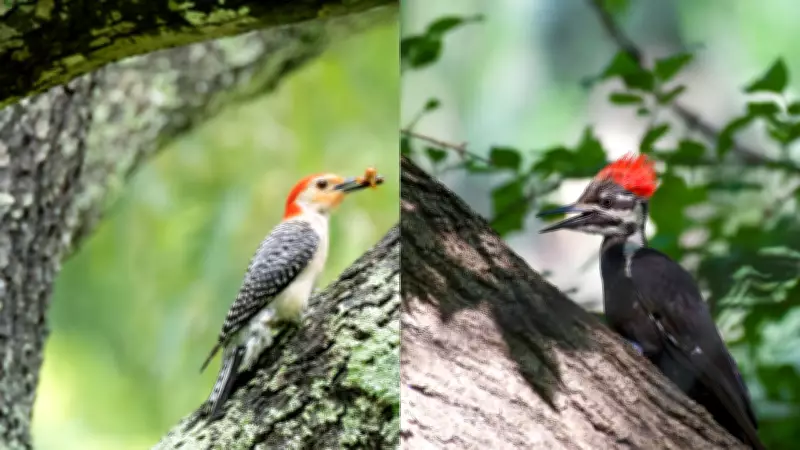
The Biomechanical Marvel of India's Woodpeckers
Imagine a crisp morning in the Nilgiris hills or the lush forests of the Western Ghats, where the sharp, rhythmic sound of a woodpecker pierces the air. In India's vibrant woodlands, species like the Rufous woodpecker and streak-throated woodpecker hammer trees relentlessly for insects, yet remarkably suffer no head injuries. If humans attempted such forceful pecking, concussions would strike swiftly. This phenomenon captivates birdwatchers from Bharatpur to aspiring students exploring nature's biomechanics. Grounded in scientific studies, this article delves into the ingenious adaptations of woodpeckers, linking global insights to India's local wildlife wonders.
Skull Structure: Nature's Built-In Shock Absorber
A woodpecker's skull functions as nature's helmet, expertly designed to handle brutal impacts. Spongy bone in the cranium, particularly a porous plate in the frontal region, absorbs shocks before they reach the brain. Researchers on AskNature note that "the cranial bone mixes dense compact bone with deeper, plate-like structures for shock absorption." In India's sal and teak forests, where White-bellied Woodpeckers thrive, this anatomical setup is especially effective. A 2011 study using finite element models demonstrated that macro and micro skull features dissipate energy superbly. Additionally, their beaks feature unequal lengths, with a longer upper mandible that spreads stress evenly, reducing peak forces during pecking.
Brain Safeguards: Compact and Cushioned Design
The woodpecker's brain itself is a tiny powerhouse, with a smooth surface lacking deep folds, which allows vibrations to distribute uniformly. Minimal cerebrospinal fluid keeps it snug, akin to a hard-boiled egg resisting shakes. As explained by AskNature, "the subarachnoid cavity's low fluid volume protects against bruising." A 2022 study by Sam Van Wassenbergh challenges previous myths, revealing that the stiff skull acts as a hammer for power, while the brain's small size—below human concussion limits—provides true defense. India's jungle fowl exhibit similar compact resilience. The hyoid bone, wrapped like a seatbelt, steadies the head post-peck, with PMC analysis via micro-CT scans confirming "the hyoid acts as a safety belt after impact."

Pecking Behavior and Muscle Power
Behavioral strategies further enhance protection. Woodpeckers peck in bursts at optimal angles, aligning their beak, skull, and spine to redirect force effectively. Head retraction limits deceleration, ensuring efficiency. Simulations from Science Org indicate that excessive absorption would drain pecking power, noting "it couldn't exert full force on wood." In Kerala or Uttarakhand trees, this efficiency provides daily meals for species like the Crimson-breasted Woodpecker. Extra padding from skin and nostril bristles, combined with mighty neck muscles, holds everything firm. Experts from The Conversation emphasize that "skull and hyoid structures exemplify impact resistance."
Evolutionary Brilliance and Conservation Implications
Woodpeckers embody evolutionary brilliance, showcasing how nature optimizes survival. Amid India's ongoing habitat conservation battles, their toughness underscores the urgency of protecting these species. Spotting one drumming on a tree is witnessing genius at work, not risk. This exploration highlights the intricate balance of anatomy and behavior that allows woodpeckers to thrive without injury, offering valuable lessons for biomechanical studies and wildlife preservation efforts across India's diverse ecosystems.