

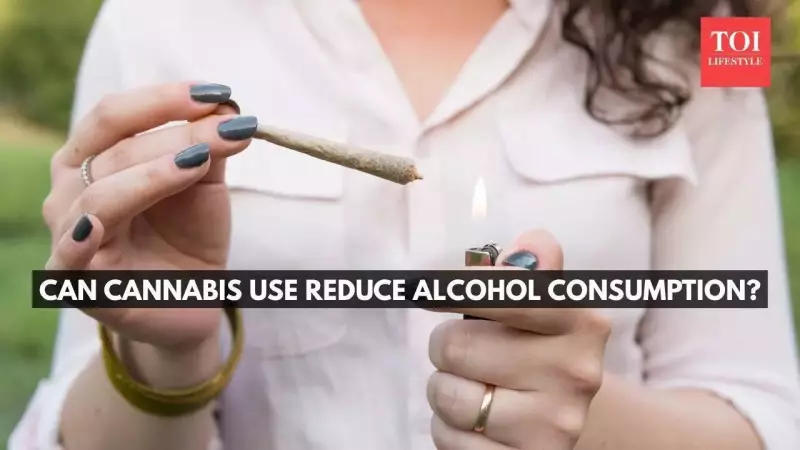
A new lifestyle movement gaining traction across America is showing surprising scientific backing. The 'California sober' trend, which involves abstaining from alcohol while using cannabis instead, may have legitimate health benefits according to groundbreaking research from Brown University.
What is California Sober?
The California sober lifestyle represents a conscious choice to eliminate alcohol consumption while continuing or starting cannabis use. Participants completely avoid other drugs and alcoholic beverages, focusing exclusively on cannabis as their psychoactive substance of choice. This trend has been particularly popular among younger adults seeking alternatives to traditional drinking culture.
Groundbreaking Research Methodology
Brown University conducted the first-ever randomized, placebo-controlled trial to directly test whether cannabis consumption affects alcohol use patterns. The study involved 157 adults aged between 21 and 44 who regularly drink heavily and use cannabis at least twice weekly.

During three separate laboratory visits, participants smoked cannabis cigarettes containing either lower THC levels (3.1%), higher THC levels (7.2%), or a placebo. Following cannabis consumption, they participated in the Alcohol Choice Task - a two-hour laboratory test conducted in a bar-like setting where participants could choose between their preferred alcoholic drink or small cash payments.
Significant Reduction in Alcohol Consumption
The findings revealed substantial decreases in alcohol consumption following cannabis use. Participants who consumed cannabis with the lower THC dose drank approximately 19% less alcohol compared to when they had the placebo. Those who used cannabis with higher THC concentrations showed an even more dramatic reduction, consuming about 27% less alcohol.
Professor Jane Metrik from Brown University explained the significance: "What we found was consistent with this idea of the substitution effect popularized by the California sober trend. Instead of seeing cannabis increase craving and drinking, we saw the opposite. Cannabis reduced the urge for alcohol in the moment, lowered how much alcohol people consumed over a two-hour period, and even delayed when they started drinking."
The Serious Health Impact of Alcohol
The research comes at a critical time, as excessive drinking remains the third leading cause of preventable death in the United States according to CDC data. Alcohol consumption is linked to approximately 200 different diseases, injuries, and cancer types. The economic impact is equally staggering, costing the US economy an estimated $249 billion annually through lost productivity, healthcare costs, and accident-related expenses.
About 60% of people diagnosed with cannabis use disorder also meet criteria for alcohol use disorder, highlighting the frequent overlap between substance use patterns.
Important Caveats and Future Research
While the short-term results are promising, researchers emphasize several important limitations. "We saw that cannabis reduces the urge in the moment. What we don't know from this study is what the long-term effect is," cautioned Professor Metrik.
The research team explicitly stated that their findings do not endorse cannabis as a therapeutic substitute for alcohol. "Cannabis itself can be addictive. Just as is the case for alcohol, there is a risk of progressing to problematic use of cannabis," they noted.
Scientists also acknowledge that laboratory conditions might not perfectly replicate real-world behavior. The team plans additional clinical trials to examine what happens when cannabis and alcohol are used together rather than sequentially, and how different cannabinoids like THC and CBD might influence alcohol consumption patterns.
As Professor Metrik summarized: "Our job as researchers is to continue to answer these questions. We can't tell anyone yet, 'You should use cannabis as a substitute for problematic or heavy drinking.'"






