

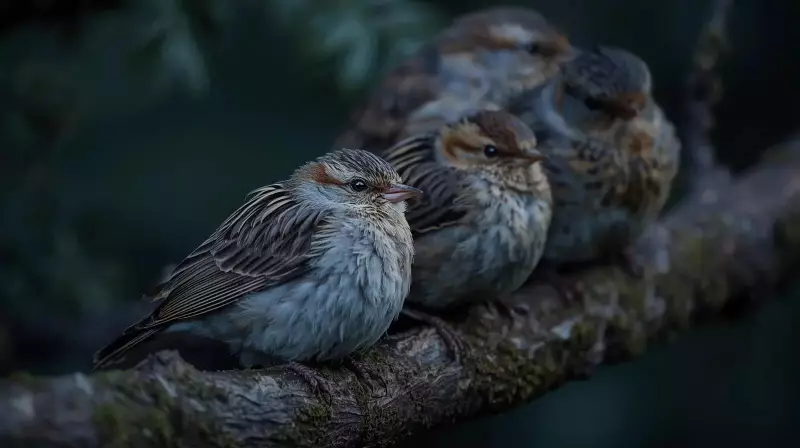
Have you ever watched a flock of birds resting peacefully on a wire or a beach and wondered how they stay safe? That serene stillness is often an illusion. For our feathered friends, sleep is rarely a complete shutdown. Instead, it's a clever, evolved compromise between the essential need for rest and the constant demand for survival.
Unihemispheric Sleep: The Brain's Clever Trick
This remarkable behaviour, where a bird sleeps with one eye open, has a scientific name: unihemispheric sleep. Researchers from Prifysgol Bangor University explain that it allows one half of the bird's brain to enter a restful state while the other hemisphere remains awake and alert. The open eye is directly connected to this active brain half, continuously scanning the surroundings for any sign of movement or threat.
This adaptation is incredibly useful in exposed environments like shorelines, open grasslands, or vast water bodies, where places to hide are scarce. Birds can thus conserve precious energy without making themselves fully vulnerable to predators. This state isn't constant. The open eye frequently closes and reopens in short bursts, a behaviour scientists often call "peeking." These brief checks enable the bird to dip into deeper rest between vigilant scans, rather than maintaining a exhausting, full-alert state continuously.

How Danger and Company Shape Rest
The level of perceived danger directly influences how a bird sleeps. Studies on species like the Eurasian oystercatcher show that birds adjust their "peeking" patterns based on nearby activity. When humans or potential threats approach their roosting spots, birds keep their eyes open for significantly longer periods.
Interestingly, dogs tend to trigger the strongest reaction, likely because their movements are unpredictable and they resemble natural predators. In contrast, routine disturbances like boat traffic lead to more frequent but shorter peeks. This indicates that birds learn to distinguish between habitual nuisances and genuine dangers. Their sleep is not a mere reflex; it's a calculated response weighing patterns, past experiences, and immediate cues.
Social dynamics also play a crucial role. Birds strongly prefer to roost in groups, as safety in numbers reduces individual risk. Research confirms that in larger flocks, individual birds peek less often, relying on the collective vigilance of many eyes. However, the mood of the group matters. If many neighbouring birds are already alert and watchful, a resting bird will instinctively increase its own vigilance. Thus, a bird's sleep is profoundly social, shaped by the group's collective anxiety as much as by the physical landscape.
The Brain Structure Behind the Behaviour
What makes this half-awake, half-asleep state possible? According to insights from the McGill Department of Bioengineering, bird brains, though different from human brains, share a key structural feature. Each hemisphere primarily processes information from the opposite side of the body. This separation allows for the unique one-sided rest.
Over time, the two brain hemispheres have developed specialised roles. This lateralisation improves neural efficiency and reduces conflict between tasks. Consequently, a bird can effectively monitor for danger with one eye and brain hemisphere while the other side manages essential functions like maintaining balance and body posture. Their vision is central to this process. Since birds' eyes are located on the sides of their heads, each eye sends a different stream of information to the brain, enabling parallel processing without overload.
The Instinctive Balancing Act of Survival
Sleeping with one eye open is not a conscious decision for birds; it is an instinct honed by millennia of evolutionary pressures. Predators, harsh weather, human disturbance, and social signals all continuously shape the depth and quality of their rest.

The cost of poor sleep is very real. Birds that remain overly vigilant burn more energy, which can lower their chances of survival, particularly during challenging seasons like winter. Yet, the cost of ignoring danger is fatal. This delicate balancing act demonstrates how behaviour adapts seamlessly, without conscious thought or planning. What humans often see as a passive state is, for birds, an active and highly responsive negotiation with a risky world. For them, rest is never just rest—it is a quiet, ongoing dialogue with their environment, conducted perpetually half-awake.





