
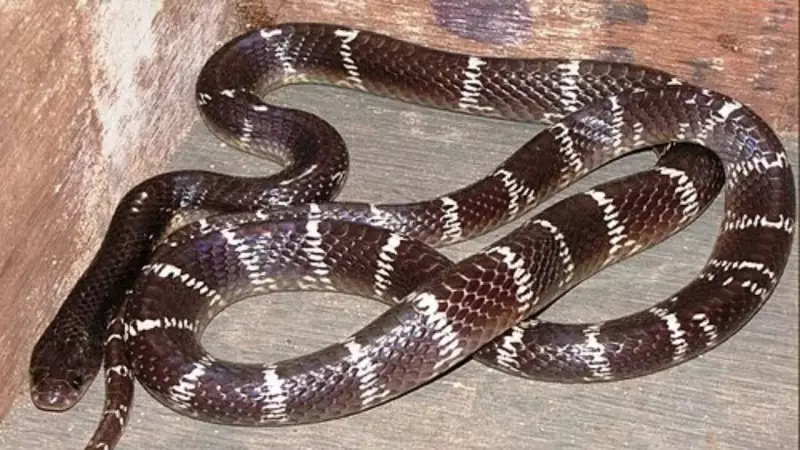
Across the Indian subcontinent, snake bites remain a critical public health challenge, deeply intertwined with local geography, human migration, and even sleep patterns. Among the many venomous species, the Common Krait (Bungarus caeruleus) holds a particularly sinister reputation. Its danger lies not in immediate agony but in a stealthy, delayed attack that can prove fatal if not recognized in time.
The Nocturnal Threat: Why Krait Bites Go Unnoticed
The Common Krait is primarily active at night, hunting rodents and small animals that thrive near human settlements. Drawn to warm, secluded spots, these snakes frequently slither into rural homes where people often sleep on the floor. The strike typically happens in the late night or early morning hours when human alertness is at its lowest.
Unlike other snakes, the krait's bite is remarkably subtle. Its fine, sharp teeth pierce the skin with minimal mechanical damage, causing little to no pain, swelling, or redness at the site. A victim might simply feel a slight pinprick or notice faint bite marks, easily dismissing it as an insect bite. This eerie characteristic has earned it the grim moniker of the 'silent killer,' often linked to mysterious deaths during sleep.
A study highlighted by the Discovery Scientific Society confirms that early envenoming cases are frequently overlooked due to this complete absence of obvious initial symptoms.
How the Venom Slowly Paralyzes the Body
The true peril of the Common Krait lies in the neurotoxic composition of its venom. The toxins specifically target the communication pathways between nerves and muscles. They work by blocking the release of acetylcholine, a crucial neurotransmitter, at the junctions where nerves signal muscles to move.
This blockade doesn't cause instant collapse. Instead, it initiates a creeping paralysis. The first signs often involve the muscles controlling the eyes and eyelids, leading to ptosis (drooping eyelids) and blurred or lost vision. If untreated, the paralysis systematically descends, affecting the muscles needed for swallowing, speaking, and, most critically, breathing.
Respiratory failure is the leading cause of death in untreated Common Krait bites. The lack of early warning signs dangerously delays victims from seeking urgent medical care, especially in remote areas where access to emergency treatment is already limited.
The Challenge of Detection and Treatment
Detecting a krait bite is notoriously difficult. It presents none of the dramatic local symptoms—like severe swelling, bleeding, or tissue necrosis—common with viper bites. The snake's efficient venom delivery means a single, brief contact can inject a lethal dose without needing a prolonged or aggressive bite.
Treating a suspected krait bite requires a high index of suspicion and careful monitoring. Antivenom is the only specific antidote, but its use must be weighed against potential adverse reactions. The decision to administer it is based on the emergence of neurological symptoms, not the appearance of the bite wound itself. This underscores the need for continuous observation after any suspected encounter.
From a public health perspective, the Common Krait exemplifies the complex interplay between environment and human health. Simple preventive measures can significantly reduce risk. These include using mosquito nets, sleeping on raised cots, keeping homes well-lit at night, and maintaining clean surroundings to deter the rodents that attract kraits. Ongoing research into the venom's nature and the snake's behavior continues to refine treatment protocols and public awareness campaigns, stressing that the absence of pain is never an indication of safety.