

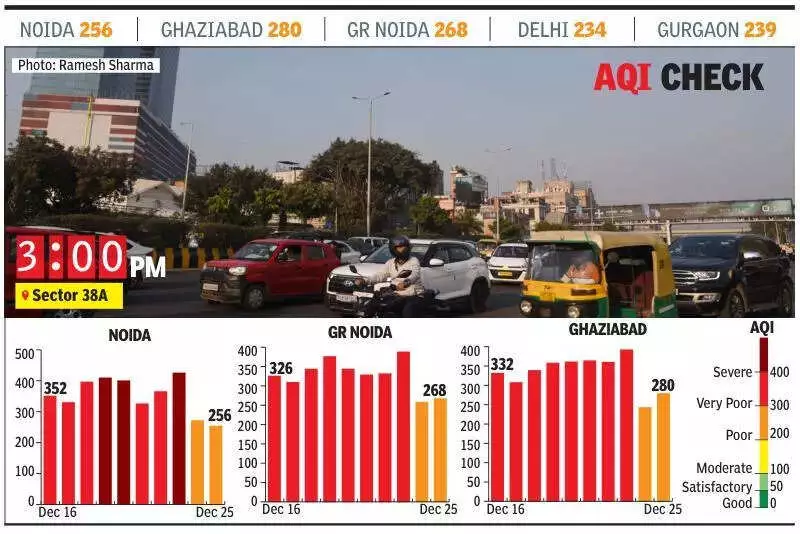
Residents of the National Capital Region (NCR) breathed a little easier on Thursday as steady winds provided a second consecutive day of improved air quality. However, the reprieve remains fragile, with pollution levels stubbornly lodged in the 'poor' category across major cities, a significant but incomplete recovery after a grueling 13-day stretch of 'very poor' and 'severe' air.
Winds Bring Temporary Relief, But Evening Calm Raises Concern
The primary driver of the improvement has been consistent northwesterly winds. On Wednesday, strong gusts reaching up to 20 kilometers per hour helped slash pollution, with Noida's Air Quality Index (AQI) dropping sharply to 273. The Indian Institute of Tropical Meteorology (IITM) reported that wind speeds moderated to around 10 kmph through Thursday afternoon, allowing gains to hold. However, a worrying trend emerged by evening as wind speeds fell below 5 kmph, increasing the risk of pollutants accumulating once again.
By Thursday, Noida recorded an AQI of 256, while Delhi logged a reading of 234. In both cities, fine particulate matter (PM2.5) remained the dominant pollutant. The improved ventilation also brought a noticeable chill, with Delhi's minimum temperature plunging to 6.5 degrees Celsius, significantly lower than Wednesday's 10.2 degrees.

Mixed Trends Across NCR: Ghaziabad Worsens, Stations Show Variance
The story across the NCR was not uniformly positive. While Delhi and Noida held their gains, early signs of reversal appeared in neighboring areas. Ghaziabad saw its AQI worsen to 280 from 244 a day earlier. Greater Noida also recorded a marginal rise, with AQI increasing to 268 from 259.
A closer look at station-wise data reveals a patchwork of air quality:
- In Noida: Sector 1 (258), Sector 125 (244), Sector 62 (238), and Sector 116 (236) all remained in the 'poor' range.
- In Greater Noida: Knowledge Park V recorded an AQI of 299, teetering on the 'very poor' threshold, while Knowledge Park III stood at 236.
- In Ghaziabad: Vasundhara slipped into the 'very poor' category with an AQI of 303. Loni (286), Sanjay Nagar (285), and Indirapuram (248) stayed 'poor'.
Delhi showed relative improvement, with only 2 out of 39 active monitoring stations in the 'very poor' category. Anand Vihar was the most polluted station in the capital with an AQI of 320.
Forecast: A Precarious Balance with Colder Days Ahead
The immediate forecast suggests a delicate balance. Air quality is likely to remain in the 'poor' category on Friday. However, scientists warn that if ventilation conditions weaken further, the region could see a slide back into the 'very poor' category by Saturday.
Adding to the concern is a predicted drop in temperature. Krishna Kumar, a scientist at the India Meteorological Department, stated that the minimum temperature is likely to dip by a degree or two in the next two days. It may hover between 6 to 8 degrees Celsius on Saturday and could fall further to between 5 to 7 degrees Celsius on Sunday. Thursday's maximum temperature was recorded at 22.6 degrees Celsius, two notches above normal.
The coming days will be critical. The region's air quality remains on a knife's edge, heavily dependent on wind speed to disperse pollutants. While the break from severe pollution is welcome, authorities and citizens are urged to remain cautious as meteorological conditions continue to evolve.






