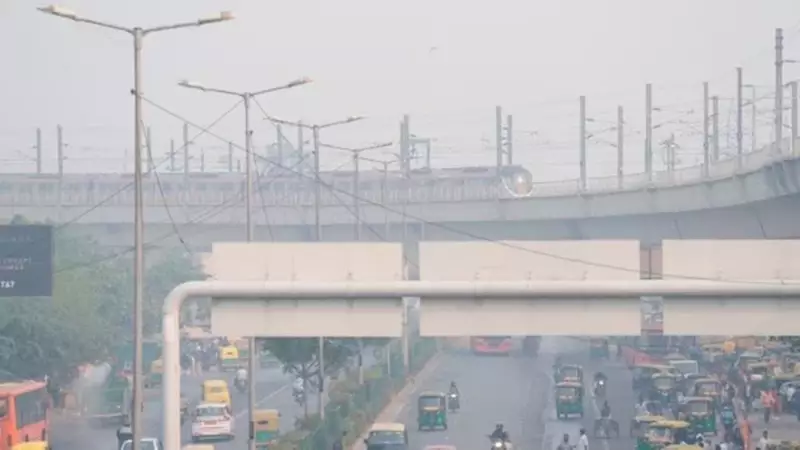
A legal plea has been filed before the Calcutta High Court, urging authorities to officially declare the dangerously worsening air quality in the Kolkata-Howrah metropolitan area as a public health emergency. This move comes in response to alarming data showing the city's pollution levels repeatedly exceeding even those of Delhi during the winter of 2025.
Unprecedented Pollution Spike Triggers Legal Action
The Public Interest Litigation (PIL), filed by advocate Akash Sharma, presents a grim picture of Kolkata's air quality crisis. According to the petition, the situation deteriorated sharply in the latter half of November 2025 with the onset of winter. Between November 20 and 28, the city's Air Quality Index (AQI) experienced wild fluctuations, swinging from a "moderate" 144 to a "severe" 417 within a single week.
The petition highlights that Kolkata briefly entered the "severe" category on November 23, signaling an early and persistent winter pollution problem rather than a temporary spike linked to festivals. By November 29, while Delhi grappled with severe smog, Kolkata's AQI was consistently in the "poor" and "very poor" zones, at times nearly matching the capital's notorious levels, with peaks reaching 417.
Kolkata Outpaces Delhi in Toxic Air Race
The most damning evidence presented in court documents relates to early December. From December 1 to 5, falling nighttime temperatures and stagnant winds caused particulate matter to accumulate near the ground. This set the stage for a shocking seven-day streak from December 6 to 12, where Kolkata's real-time AQI remained consistently higher than Delhi's every single day.
During this period, AQI values in the City of Joy fluctuated between 184 and 439, repeatedly breaching "very poor" and "severe" thresholds. The crisis reached a terrifying peak on the evening of December 11, 2025. Kolkata recorded an AQI of 439, which then skyrocketed to an almost off-the-charts 558 at around 11:04 PM. This placed the city firmly in the "severe" or "hazardous" category and decisively surpassed the worst readings from Delhi during the same period.
PIL Alleges Government Inaction, Seeks Court Intervention
The petitioner, Akash Sharma, states that he had forewarned authorities of the impending winter pollution. On November 12, 2025, he submitted a detailed representation to the Chief Secretary, the Chairman of the West Bengal Pollution Control Board (WBPCB), and the Principal Secretary of Environment. He specifically requested the formulation and implementation of a structured Graded Response Action Plan (GRAP), similar to Delhi's model, to tackle the crisis.
In response, the WBPCB reportedly emailed him on November 18, 2025, stating it was "undergoing research and preliminary testing for implementing a software-based GRAP." The petition argues that this vague response failed to notify any time-bound or legally enforceable measures to protect public health immediately.
The PIL contends that this recurring and severe pollution violates citizens' fundamental right to clean air under Article 21 of the Constitution, which guarantees the right to life and personal liberty. It frames the toxic air as an ongoing public health emergency demanding urgent judicial oversight.
The petition seeks several directives from the court:
- Court-monitored enforcement of existing environmental laws.
- The creation and implementation of a formal, actionable GRAP for Kolkata.
- The establishment of an expert task force to manage the crisis.
- Strict bans on waste burning and tighter controls on vehicular and industrial emissions.
A division bench led by Acting Chief Justice Sujoy Paul is scheduled to hear this critical matter on January 19. The court's decision could mandate a new, aggressive approach to combating air pollution in one of India's largest and most densely populated metropolitan regions.