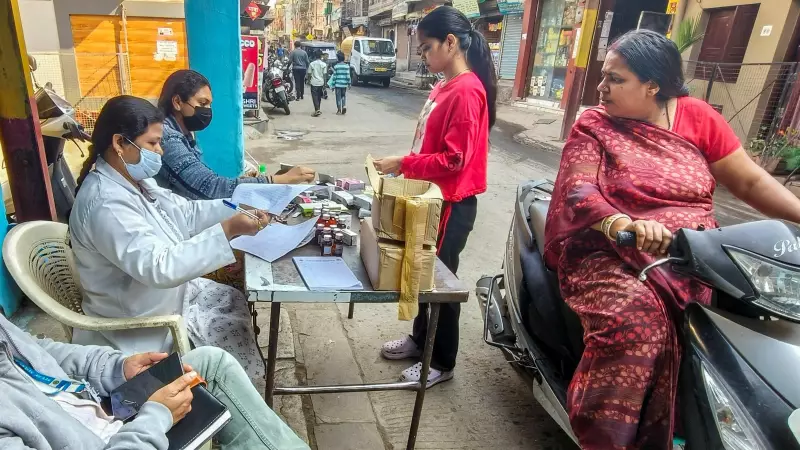
The death toll from contaminated water in Indore's Bhagirathpura area has risen to eight, with over 200 hospitalised, in a public health disaster that unfolded despite months of desperate warnings from residents. Official records and testimonies reveal a trail of ignored complaints and stalled bureaucratic processes that allowed sewage to mix with drinking water, leading to the crisis.
A Trail of Ignored Warnings
The first official distress signal was logged two months before the tragedy. On October 15, 2025, Dinesh Bharati Verma filed a complaint on the Indore Mayor's helpline, warning that borewell water was mixing with drain water near a temple in the congested Ward 11 of Bhagirathpura. By mid-November, the complaint turned more alarming. Resident Shivani Thakle reported the presence of "acid in the dirty water."
As December progressed, the pleas became dire. On December 18, residents reported a "foul stench" in the Narmada supply. By December 28, Ganesh Paraskar and Yash Parewa informed authorities that 90% of Ward 11 was falling ill with severe vomiting, diarrhoea, and dehydration. The administration finally swung into action on December 29, only after the first deaths were reported.
Bureaucratic Lapse and a Pending Pipeline File
Local corporator Kamal Waghela, under whose jurisdiction the area falls, confirmed that a demand for laying a new Narmada water pipeline was raised last year. A file was prepared on November 12, 2024, and a tender was floated on July 30, 2025. However, Waghela alleges the file was "kept unnecessarily pending for nearly seven months." In a letter to Chief Minister Mohan Yadav, he called the incident a result of "grave criminal negligence."
The work order to execute the final leg of this crucial project was passed only on December 26, 2025, coinciding with the emergence of deaths. This delay occurred despite municipal records showing that in 2025 alone, Indore received 266 water quality complaints citywide, with 23 from Zone 4, which includes Bhagirathpura.
Officials Point to Congested Infrastructure and Overlap
Bablu Parshad, the area's water works in-charge, described Bhagirathpura as an infrastructural nightmare with narrow roads and a collapsed sewage system. He claimed warnings about the need for replacement lines were raised repeatedly but ignored.
Meanwhile, Additional Commissioner Rohit Sisonia, responsible for tenders, defended the pace of work. He stated that repairs were staggered and integrated with the central AMRUT 2.0 scheme. Sisonia claimed that around 80% of work on two major lines was complete, and work on the third began on December 26. He identified the source of contamination as a police chowki's bathroom, built over the main water line without a safety tank, leading to a leak.
Aftermath and Accountability
The suspended Assistant Engineer for Zone 4, Yogesh Joshi, claimed he managed three zones alone and that the head office was aware of the damaged pipelines for at least a year. The municipal corporation has now set up a control room for contamination complaints.
Officially, the administration has linked four deaths and 212 hospitalisations to the contaminated water, though the local reported death toll stands at eight. The incident underscores a catastrophic failure in civic response, where clear, early warnings about water quality were systematically overlooked until it was too late.