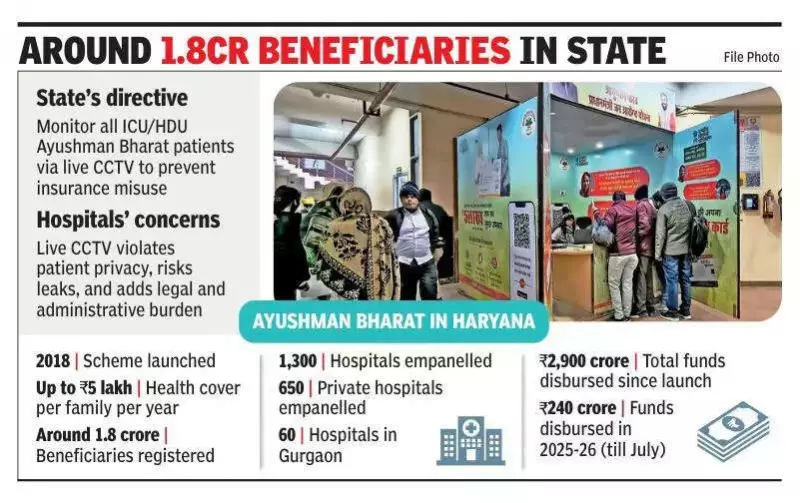
The Haryana government has issued a directive requiring all hospitals empanelled under the Ayushman Bharat-Pradhan Mantri Jan Arogya Yojana (AB-PMJAY) to implement continuous live CCTV surveillance in their High Dependency Units (HDUs) and Intensive Care Units (ICUs). The order, aimed at preventing misuse of the insurance scheme, mandates that the live feed be shared with the state health agency for verification, monitoring, and processing claims.
A Directive for "Strengthening Oversight"
The directive was issued on Wednesday by the Chief Executive Officer of the Haryana Health Protection Authority. It explicitly states that all Ayushman Bharat beneficiaries admitted to HDUs and ICUs, with or without ventilator support, must be kept under continuous live CCTV camera surveillance. The cameras must be positioned to allow verification of the patient's presence and the care being delivered, while also ensuring patient dignity and privacy.
Hospitals have been instructed to provide the real-time CCTV link to the State Health Agency immediately. The government has clarified that the live feed will be used solely for verification, monitoring, audit, and processing of claims under AB-PMJAY. The order holds the medical superintendent or the authorised Ayushman Bharat nodal officer of the hospital personally responsible for compliance.

To prevent misuse, hospitals must install technical safeguards against tampering with the footage. The CCTV footage is not to be shared with any unauthorised person or agency. Non-compliance could result in fines, suspension, or even de-empanelment from the lucrative health scheme.
Medical Community Flags Privacy and Ethical Concerns
The move has drawn sharp criticism from the medical fraternity, led by the Indian Medical Association (IMA). Doctors argue that live video monitoring of critical care areas constitutes a severe breach of patient confidentiality and medical ethics.
Dr. Ajay Mahajan, former president of the IMA's Haryana chapter, told the Times of India that filming ICUs would inevitably capture exposed bodies, invasive procedures, and moments of extreme patient distress. He warned that even with safeguards, live streaming expands the risk of leaks or misuse of highly sensitive footage. Dr. Mahajan also pointed out that this directive is against the guidelines of the National Accreditation Board for Hospitals (NABH), which upholds a patient's right to dignity, privacy, and informed consent.
Doctors further highlighted that patients in ICUs are rarely in a condition to grant informed consent for such surveillance. They also distinguished this real-time monitoring for an external authority from routine internal hospital security surveillance. The Digital Personal Data Protection Act, 2023, which classifies health information as "sensitive personal data," adds another layer of legal complexity to the issue.
Background and Scale of the Scheme in Haryana
Launched by the central government in 2018, Ayushman Bharat provides an annual health cover of up to Rs. 5 lakh per family to low-income households. In Haryana, approximately 1.8 crore (18 million) people from eligible families are registered under the scheme. Around 1,300 hospitals, including 650 private institutions, are empanelled in the state to provide cashless treatment.
Under the scheme's framework, empanelled hospitals treat beneficiaries free of charge and later raise reimbursement claims with the government via an online portal. These claims are reviewed and cleared by the state agency before payments are disbursed.
This directive comes against a backdrop of previous tensions over reimbursements. In August 2025, private hospitals across Haryana had temporarily pulled out of AB-PMJAY, citing nearly Rs. 500 crore in pending reimbursements. The state government, however, stated it had cleared Rs. 2,900 crore since the scheme's inception. Data showed that Rs. 240 crore was disbursed by the state and centre till the first quarter of the 2025-2026 fiscal year.

The new CCTV surveillance order represents a significant push by the Haryana government to tighten oversight and curb fraudulent claims. However, it sets the stage for a critical debate balancing administrative accountability with the fundamental rights to privacy and ethical medical care for some of the state's most vulnerable patients.