

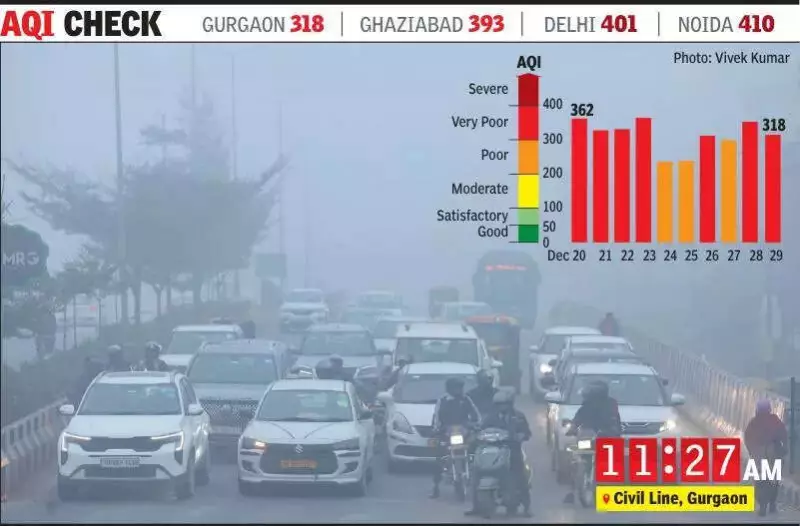
For the second day in a row, Gurgaon's air quality languished in the 'very poor' category on Monday, posing significant health risks to residents. The city's overall Air Quality Index (AQI) was recorded at 318, showing only a marginal dip from Sunday's reading of 353. This persistent toxic haze indicates that the winter smog spell has firmly set in over the National Capital Region (NCR).
Monitoring Stations Paint a Grim Picture
Data from all four active monitoring stations in the city revealed a consistently polluted environment. Vikas Sadan emerged as the most polluted location with an AQI of 360, firmly in the 'very poor' band. It was followed by Gwalpahari (309) and Sector 51 (307), also in the same severe category. Teri Gram was the sole station to record a slightly better, though still unhealthy, 'poor' AQI of 285.
PM2.5 Levels Sky-High, Far Exceeding Safe Limits
The primary culprit behind the dangerous air was fine particulate matter, or PM2.5. At a microscopic size, these particles penetrate deep into the lungs and bloodstream. Vikas Sadan recorded a staggering PM2.5 concentration of 354 micrograms per cubic metre (µg/m³). Gwalpahari, Sector 51, and Teri Gram followed with 312 µg/m³, 267 µg/m³, and 234 µg/m³ respectively.

For PM10 (coarser particles), Teri Gram led with 330 µg/m³. These numbers are alarmingly higher than the safe standards set by the Central Pollution Control Board (CPCB), which are 60 µg/m³ for PM2.5 and 100 µg/m³ for PM10 for a 24-hour average.
Officials Cite Trapped Pollutants, Forecast Worsening Air
Officials from the Haryana State Pollution Control Board (HSPCB) attributed the situation to a combination of local emissions and extremely poor weather conditions for dispersion. A regional officer explained that wind speeds have dropped to around 3 kilometres per hour, creating a lid over the city that traps pollutants close to the ground.
The forecast is not encouraging. The Decision Support System (DSS) predicts that 'very poor' air will persist over Delhi-NCR until December 31st. Alarmingly, the AQI is likely to slip into the 'severe' category on January 1, 2026, as the ventilation index remains unfavourably low.
Health Advisory and Broader NCR Context
With the AQI in the 301-400 ('very poor') range, prolonged exposure can cause breathing discomfort for most people. Doctors strongly advise residents to:
- Avoid strenuous outdoor activities, especially during morning and evening hours.
- Wear N95 or equivalent masks when spending long durations outside.
- Use air purifiers indoors and keep windows closed when pollution is high.
- Monitor symptoms, especially children, the elderly, and those with pre-existing respiratory or heart conditions, and seek medical help if needed.
The situation in the wider region remains critical. Neighbouring Delhi saw its air quality turn 'severe' on Monday afternoon, with an AQI of 401, worsening from the 'very poor' 390 recorded a day earlier. This underscores the regional nature of the winter pollution crisis gripping north India.






