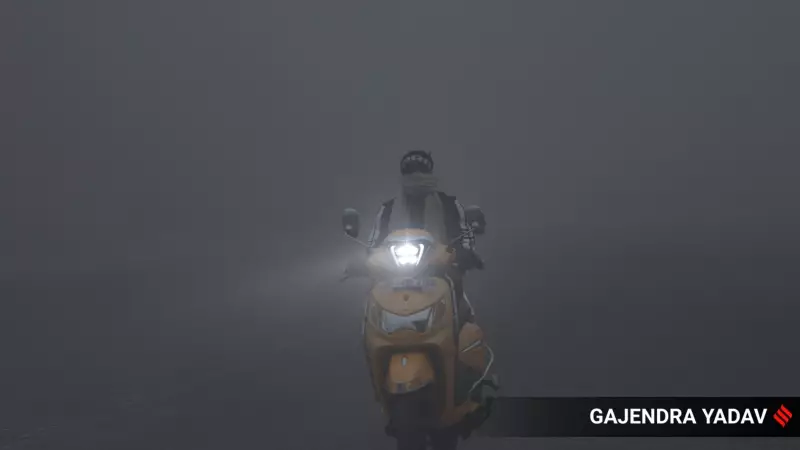
Delhi woke up to a dual environmental crisis on Saturday, marking the season's first official 'cold day' even as its air quality plummeted, hovering dangerously close to the 'Severe' category. The capital was blanketed under a dense, grey pall of fog and pollution, severely reducing visibility and raising health concerns.
Chilling Temperatures and Thick Fog Grip the Capital
According to the India Meteorological Department (IMD), Saturday met the criteria for a 'cold day' for the first time this winter. The maximum temperature at Safdarjung, Delhi's base weather station, plunged to 16.9 degrees Celsius, which is a significant 5.3 degrees below the normal for this time of year. The Palam station recorded an even lower day temperature of 16.3°C.
The minimum temperature settled at 6.1 degrees Celsius, two notches below normal. The IMD states a 'cold day' is declared when the minimum is 10°C or below and the maximum is 4.5-6.4°C below normal. Visibility was drastically reduced, with Safdarjung airport recording only 200 metres at 8:30 AM, though it improved slightly to 400 metres by the afternoon.
Air Quality Worsens, Noida in 'Severe' Zone
As the mercury dropped, the air quality index (AQI) rose alarmingly. Delhi's average AQI stood at 398, placing it in the 'Very Poor' category and inching perilously close to the 'Severe' mark of 401. This was a deterioration from Friday's reading of 374.
The situation was even more critical in the National Capital Region (NCR). Noida remained entrenched in the 'Severe' category with an AQI of 401, while Gurgaon recorded an AQI of 362 in the 'Poor' category, showing a significant worsening from the previous day.
Forecast agencies have warned that Delhi's air quality is likely to slip into the 'Severe' category on Sunday and Monday, indicating no immediate relief for residents.
Sources of Pollution and External Factors
Data from the Indian Institute of Tropical Meteorology’s Decision Support System pinpointed the major contributors to Delhi's PM2.5 pollution. The transport sector remained the largest local contributor at 17.57%. Delhi and its peripheral industries accounted for about 8%, while residential emissions contributed 4.34%.
Pollution flowing in from neighbouring states continued to play a substantial role. Jhajjar in Haryana was the highest external contributor, responsible for 16.51% of Delhi's PM2.5 load. Other significant contributors included Rohtak (4.3%), Bhiwani (4.2%), and Gurgaon (around 2%).
The combination of low temperatures, calm winds, and high humidity has trapped pollutants close to the ground, creating the toxic haze. Authorities continue to implement measures under the Graded Response Action Plan (GRAP) to control emissions from various sources.