

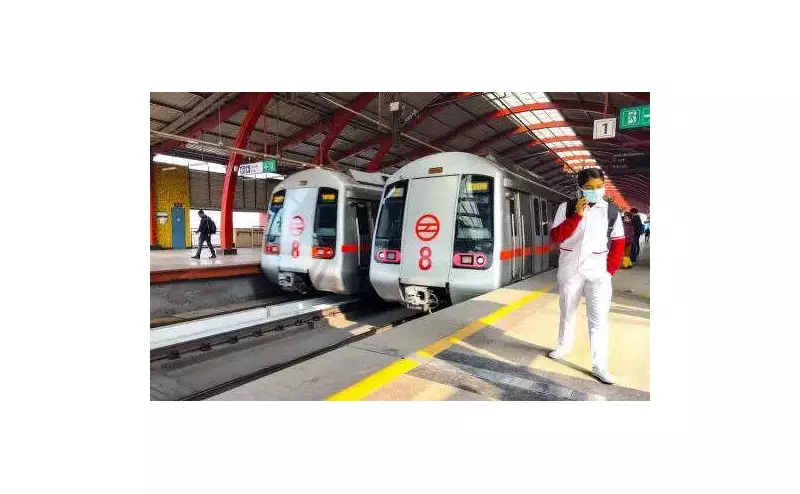
A groundbreaking study has revealed stark differences in air pollution exposure for Delhi's commuters depending on their choice of transport. Research led by scientists from the Council of Scientific & Industrial Research–Central Road Research Institute (CRRI) and the International Institute of Health Management and Research found that the Delhi Metro offers the safest environment, while auto-rickshaws pose the greatest health risk from fine particulate matter.
Shocking Disparity in Pollution Exposure
The study, published in the journal Discover Atmosphere, was conducted over 18 days in March 2019. It measured real-time pollution along a 10.46-kilometer stretch of the Delhi Metro's Magenta Line, specifically between Kalkaji Mandir and Munirka stations during peak traffic hours. The findings present a clear hierarchy of pollution risk for daily travelers.
The average PM2.5 exposure inside air-conditioned metro coaches was measured at just 34.2 micrograms per cubic metre. This is significantly lower than India's national safe limit of 60 micrograms per cubic metre for this harmful pollutant. In stark contrast, commuters in open auto-rickshaws were subjected to an alarming average of 113.2 micrograms per cubic metre—nearly double the permissible standard.

How Other Transport Modes Compare
The research team meticulously recorded exposure levels across various common modes of transport in the capital. The data paints a detailed picture of the commuting environment in one of the world's most polluted cities.
- Two-wheelers: 41.9 micrograms per cubic metre
- Buses with windows open: 68.9 micrograms per cubic metre
- Buses with windows closed: 63.1 micrograms per cubic metre
- Cars with windows closed: 62.3 micrograms per cubic metre
- Cars with windows open: 71 micrograms per cubic metre
A key takeaway from the data is the significant protective effect of enclosed, air-conditioned vehicles. Senior principal scientist S Padma from CRRI noted that the higher concentration in auto-rickshaws compared to two-wheelers was likely due to the latter's more ventilated environment, though she clarified the study did not investigate this aspect in depth.
Commuters' Perception vs. Reality
In addition to physical monitoring, the study incorporated a survey of 317 commuters at metro stations and bus stops. The aim was to understand public perception of pollution exposure across different transport options.
While a majority of respondents correctly identified the metro as the least polluting mode, their awareness of the relative risks between other transport types was limited. Co-author Dr. Nitish Dogra, a public health physician and Fulbright Fellow, emphasized that closed public transport systems, especially the metro with its underground sections, consistently showed lower pollution levels compared to vehicles operating on open roads.
The monitoring captured a range of pollutants including PM1, PM2.5, PM10, carbon monoxide, and black carbon, with measurements taken daily at the same time under similar traffic conditions averaging 20–25 kmph. This comprehensive approach underscores the metro's role not just as a transit solution, but as a critical public health intervention for Delhi's residents, offering a refuge from the city's toxic air during daily commutes.






