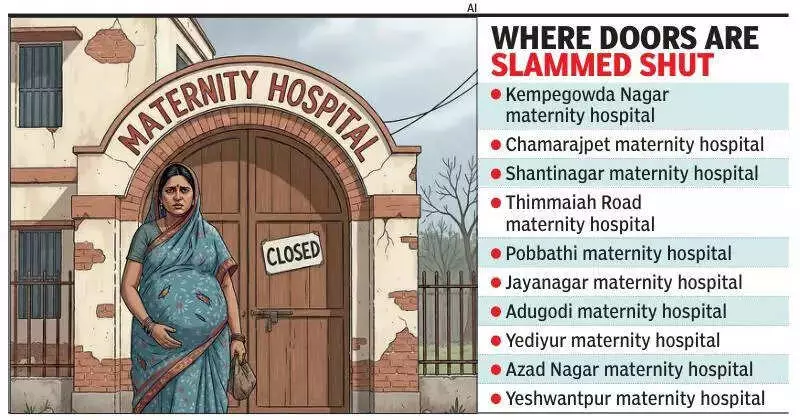
The closure of ten maternity hospitals managed by the Greater Bengaluru Authority (GBA) has created a severe crisis for affordable maternal healthcare in the city. The shutdown, due to ongoing construction and renovation work, is forcing thousands of expectant mothers, especially from low-income and migrant backgrounds, to seek costly alternatives or travel long distances.
Infrastructure Upgrades Leave Critical Gaps
The GBA oversees a significant network of public health facilities, including six referral hospitals, 28 maternity hospitals, and two general hospitals, along with Namma Clinics and urban primary health centres. However, the simultaneous closure of 10 maternity hospitals for infrastructure upgrades has drastically reduced accessible public maternity care in multiple neighbourhoods.
A senior GBA health official explained that while building construction in Yeshwantpur was finished years ago, the facility remains non-operational due to a lack of essential medical equipment and supporting infrastructure. In other locations, renovation and construction work is still in progress, delaying the reopening of services indefinitely.

Stories of Struggle and Financial Hardship
The impact on the ground is profound and distressing. Lakshmi Manikandan, a 26-year-old expectant mother from Shantinagar, shared her ordeal. "I used to go to the Shantinagar maternity hospital for all my check-ups. Now it is shut and the nearest government hospital is far away," she said. "Private hospitals are asking for Rs 60,000 to Rs 1,60,000 for delivery, which we simply cannot afford. My husband is a daily-wage worker, and travelling so far every time is exhausting."
Salma Begum, a migrant worker living in Adugodi, faces a similar challenge. "My first child was delivered at Adugodi maternity hospital. This time, for my second pregnancy, the hospital was closed and I was forced to visit a private clinic where even basic tests cost so much," she lamented.
The shutdown has disproportionately affected:
- Daily-wage workers
- Migrant labourers
- Economically weaker sections
These communities primarily depend on government maternity hospitals for affordable antenatal care and deliveries. With these options gone, they are left with unaffordable private care or overburdened government facilities in other parts of Bengaluru.
Administrative Hurdles and Future Plans
Compounding the problem is administrative confusion following the transition from the Bruhat Bengaluru Mahanagara Palike to the GBA and the creation of five city corporations. Hospitals shifting jurisdictions, like some from the former West zone to the North city corporation, have faced incomplete paperwork and administrative delays, even triggering salary issues for staff.
Current capacity in functioning maternity hospitals is also limited, with beds ranging from as few as 12 to 30. Under the Brand Bengaluru project, the GBA has plans to upgrade infrastructure, aiming to expand about 14 hospitals to 30 beds and five others to 50 beds. However, a health official admitted this process is moving "at a snail's pace."
Health department officials state that services will resume in a phased manner. In hospitals where building work is complete, outpatient services will start first, with inpatient services following only after all remaining work is finished. For now, the wait for accessible, affordable maternal healthcare continues for Bengaluru's most vulnerable residents.