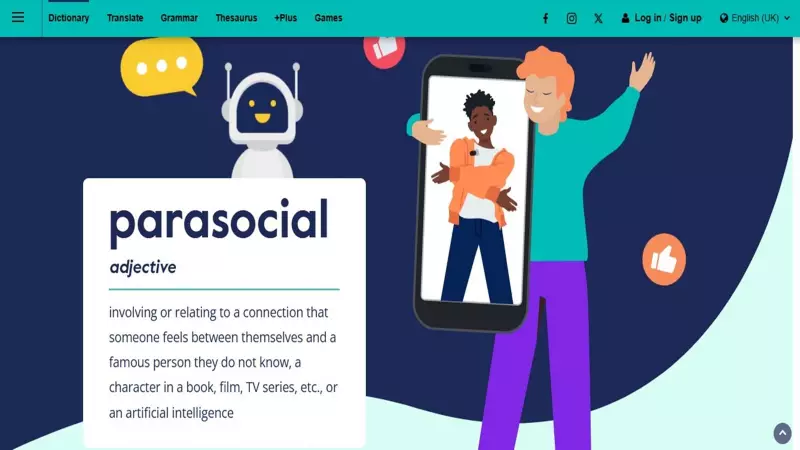
The Cambridge Dictionary has officially announced its Word of the Year for 2025, selecting the term 'parasocial' to define a significant modern social phenomenon. This adjective describes the one-sided connection a person feels with a famous individual, a fictional character, or even an artificial intelligence, a dynamic increasingly prevalent in today's digitally-driven world.
What Does 'Parasocial' Mean and Why Did It Win?
According to the prestigious lexicon, a parasocial relationship involves a connection that feels real and intimate to the fan but is not reciprocated by the other party. The word saw a massive spike in searches on June 30, 2025, following an incident where popular YouTube streamer IShowSpeed blocked a fan who identified as his 'number 1 parasocial'.
The dictionary's editors noted that conversations this year have heavily featured discussions about parasocial relationships with AI chatbots, showing that the issue extends far beyond traditional celebrities and influencers. This broad relevance cemented its position as the top word.

The other strong contenders for the title were 'pseudonymization', a data privacy process, and 'memeify', the act of turning something into a meme. This follows the selection of 'manifest' as the 2024 Word of the Year.
A Psychologist's Take on the Parasocial Shift
According to Dr. Rimpa Sarkar, a counselling psychologist and Founder of Sentier Mind & Sentier Wellness LLP, this choice highlights a profound change in human interaction. 'We are increasingly building one-sided relationships with influencers, creators, public figures and also AI – relationships that feel intimate to us, but aren't reciprocal,' she explained.
Dr. Sarkar emphasized that while parasocial bonds are not a new concept, social media has dramatically intensified them. Platforms allow creators to share curated slices of their lives that feel personal, accessible, and emotionally charged, fostering a false sense of intimacy.
The negative consequences of this are visible in the rise of trolling and doxing that public figures face, often over trivial matters, from fans who feel an unwarranted sense of personal entitlement.
The Long-Term Impact on Mental Health and Real Relationships
Dr. Sarkar warns that when these digital bonds replace genuine human connection, the long-term effects on mental health and the ability to form real relationships can be severe.
Key impacts include:
- People entering relationships with idealized and unrealistic expectations of emotional availability.
- Difficulty in handling real-world conflict due to a lack of practice, as parasocial bonds involve no disagreements.
- Increased feelings of comparison, jealousy, and dissatisfaction with real-life partners.
- Reinforcement of avoidant or anxious attachment styles, where some shun real intimacy while others become overly attached to virtual figures.
- Substitution of real-world support systems with digital comfort, leading to long-term loneliness and reduced resilience.
In moderation, these relationships can offer comfort, but Dr. Sarkar cautions that over-reliance can lead to unrealistic expectations from partners, difficulty with emotional regulation, and a fragile sense of self-worth.
How to Strike a Healthy Balance
To avoid the pitfalls of parasocial relationships, Dr. Sarkar offers the following advice:
First, maintain awareness that online content is a curated performance, not genuine intimacy. It is crucial to balance digital consumption with real-life connections, aiming for at least one meaningful, face-to-face interaction every day.
Setting emotional boundaries is also essential. If an online personality starts to excessively influence your mood or well-being, it is a sign to take a step back and detox. Finally, be vigilant for early red flags, such as constantly comparing your partner to an online creator, obsessively following someone's life, or feeling an intense, personal attachment to someone who does not know you exist.