

Turmeric Compound Engineered into Revolutionary Cancer Treatment System
In a significant breakthrough that could transform oncology, researchers at Maharaja Sayajirao University (MSU) in Vadodara have developed an innovative "smart" drug delivery platform using curcumin—the active component of turmeric—that precisely targets cancerous tumors while simultaneously illuminating them for real-time monitoring. This advancement addresses one of chemotherapy's most persistent limitations: its inability to distinguish between malignant and healthy cells, which often leads to severe side effects and organ damage.
Addressing Chemotherapy's Fundamental Flaw
The research team, led by Professor Sonal Thakore from the Department of Chemistry in the Faculty of Science, along with researchers Twara Kikani and Krutika Patel, focused on creating a system that overcomes the indiscriminate nature of conventional chemotherapy. "Traditional chemotherapy effectively destroys cancer cells but fails to differentiate between healthy and cancerous tissues, resulting in significant toxicity and adverse effects," explained Thakore. "Our objective was to design a sophisticated delivery mechanism that not only transports medication directly to tumor sites but also provides visual feedback throughout the treatment process."
The Science Behind the Smart Delivery Platform
The scientists chemically engineered curcumin into specialized molecules that exhibit Aggregation-Induced Emission (AIE)—a phenomenon where the compound emits intense fluorescence when it accumulates within tumor tissue. When this modified curcumin reaches cancerous areas, it generates a bright fluorescent signal that acts as a biological spotlight, enabling medical professionals to visually locate cancer cells and monitor tumor reduction in real time without invasive procedures.

This dual-function system represents a theranostic platform that combines therapeutic action with diagnostic capabilities. "It's an integrated approach where the same delivery mechanism administers treatment while providing imaging functionality," Thakore elaborated. "This innovation reduces reliance on repeated biopsies and multiple scanning sessions, making cancer management less invasive and more efficient."
Nanomicelles: The Precision Delivery Vehicles
The chemotherapy drugs are encapsulated within nanomicelles—minuscule carriers that function like GPS-guided delivery systems. These nanomicelles remain stable while circulating through the bloodstream but respond specifically to the acidic microenvironment characteristic of tumor tissue. Upon detecting this unique environment, they release both the therapeutic agents and fluorescent curcumin molecules directly at the cancer site.
"In practical terms, the nanomicelles travel safely through the body and only activate when they encounter tumor tissue," Thakore described. "This targeted release mechanism enhances drug efficacy dramatically while minimizing collateral damage to vital organs such as the heart, liver, and kidneys."
Research Validation and Future Prospects
The study, funded by the Anusandhan National Research Foundation (ANRF) in New Delhi and published in the prestigious peer-reviewed journal Biomacromolecules of the American Chemical Society, included comprehensive in vivo testing on mice conducted in collaboration with Nirma University in Ahmedabad. Experiments on breast and liver cancer cell lines and animal models demonstrated substantially improved drug effectiveness with minimal impact on critical organs.
Because the system utilizes biocompatible and naturally derived components, it offers potential advantages in safety and affordability compared to synthetic alternatives. "The next phase involves expanded studies and exploring industry partnerships to advance clinical translation," Thakore added. If successfully scaled, this innovation could establish a new paradigm for precise, patient-friendly, and cost-effective cancer care.

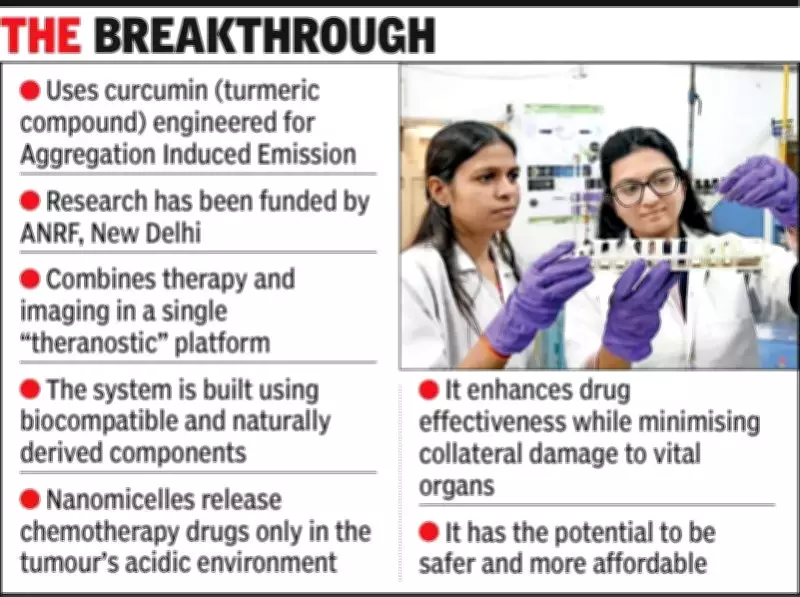
Key Features of the Breakthrough Technology
- Utilizes curcumin from turmeric engineered for Aggregation-Induced Emission
- Research supported by ANRF, New Delhi
- Integrates therapy and imaging into a single theranostic platform
- Constructed from biocompatible and naturally derived materials
- Nanomicelles release chemotherapy drugs exclusively in tumor acidic environments
- Enhances drug effectiveness while protecting vital organs
- Promises safer and more affordable treatment options
This pioneering work represents a significant step toward a future where cancer treatment no longer requires patients to endure toxic side effects as a trade-off for tumor destruction. By harnessing the natural properties of a common kitchen spice, Indian scientists have potentially unlocked a more humane and effective approach to oncology.





