

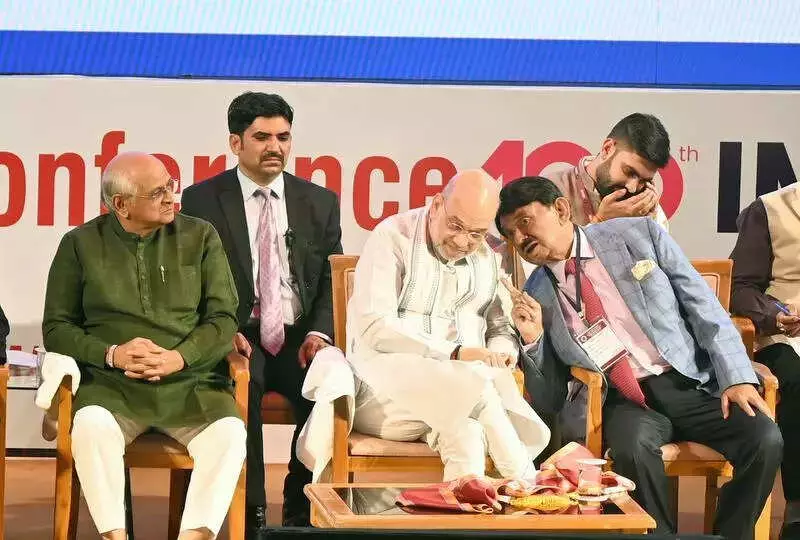
Union Home and Cooperation Minister Amit Shah has called for a comprehensive review of ethical standards within the medical profession, urging the Indian Medical Association (IMA) to lead this crucial update. Speaking at the All India Medical Conference, IMA-NATCON 2025, in Ahmedabad's Shela area, Shah emphasized that ethical frameworks established a century ago may no longer suffice for contemporary healthcare challenges.
A New Ethical Framework for Modern Medicine
Amit Shah directly appealed to the IMA to form a dedicated team tasked with redefining the dimensions of medical ethics. He argued that the scope of ethics crafted 100 years ago requires re-examination to remain relevant to today's circumstances. "The dimensions of ethics of this profession should be re-examined," Shah stated, highlighting the need for principles that align with present-day scenarios.
Furthermore, the Minister urged the IMA to submit a formal proposal to the Union government to integrate a robust ethics module into medical education curricula nationwide. He firmly believes that mastery of medical science alone does not make a successful doctor. "Ethics are moral in nature and cannot be enforced by law," Shah remarked, stressing that ethical grounding must be cultivated during education itself. He expressed confidence that this inclusion would produce more compassionate doctors who view service as their primary duty.

Celebrating Public Health Milestones and Future Plans
In his address, Shah showcased significant achievements in India's public health sector. He announced an impressive 97% reduction in malaria cases across the country, attributing this success to flagship government initiatives like Ayushman Bharat and Mission Indradhanush. "We will be almost free from malaria in a short time," Shah projected optimistically.
He also shared other critical improvements: the government has successfully reduced the mortality rate in dengue to just about 1%, and there has been a substantial 25% reduction in maternal mortality rates. Shah credited these outcomes to the "holistic health ecosystem" approach adopted over the past decade, backed by a substantial increase in the health budget—from Rs 37,000 crore in 2014 to Rs 1.28 lakh crore under Prime Minister Narendra Modi's leadership.
Government Schemes and a Call for Collaboration
Amit Shah outlined upcoming initiatives and called for greater synergy between private medical practitioners and government programs. He revealed that the Union government, through AIIMS, will soon launch a program to provide guidance to Primary Health Centres (PHCs) and Community Health Centres (CHCs) using telemedicine and videography.
He requested the IMA to prepare a roster of doctors willing to volunteer three hours daily to offer diagnoses to needy citizens via this expanding telemedicine network. Shah also expressed clear dissatisfaction with attempts by some doctors to diminish the value of the Ayushman Bharat scheme or the provision of generic medicines. "There is a vacuum, and it has to be filled. You are not in competition with anyone," he told the gathering, asking them to stop belittling these essential efforts.
Addressing Concerns on Doctor Protection Laws
Responding to demands from the medical fraternity for stronger legal protections, Amit Shah provided a status update. He informed the conference that 22 states have already enacted relevant laws, while six have not. However, he pointed out a critical implementation gap, suggesting that merely having a law on paper is ineffective without proper enforcement.
Concluding his speech, Shah encouraged doctors to align their efforts with the infrastructure and schemes being established by the government to ensure maximum impact and better health outcomes for all citizens.






