

Pune Hospital Performs Complex Surgery to Save Woman from Rare Autoimmune Condition
In a remarkable medical achievement, surgeons at the PCMC-run Yashwantrao Chavan Memorial (YCM) Hospital in Pune have successfully operated on a 20-year-old woman suffering from an extremely rare autoimmune disorder. This condition caused her spleen to swell to five times its normal size, putting her at severe risk of liver failure. The complex seven-hour procedure not only saved her life but also eliminated the need for a future liver transplant, marking a significant victory for the medical team.
A "Triple Threat" Health Crisis with Global Rarity
The patient was battling what doctors described as a "triple threat" health crisis—a rare combination of conditions seen in fewer than 5% of similar cases worldwide. Her immune system was aggressively attacking both her liver and its blood vessels, leading to a condition known as non-cirrhotic portal fibrosis (NCPF). This autoimmune assault caused her spleen to expand dramatically to 700 grams, far exceeding the normal weight of approximately 150 grams.
The enlarged spleen began trapping and destroying her red blood cells, white blood cells, and platelets, resulting in chronic anaemia and constant exhaustion. Before the surgery, she required expensive, frequent blood transfusions and endoscopic examinations just to stay alive, severely impacting her quality of life and educational pursuits.

High-Stakes Surgical Intervention with Micro-Vascular Techniques
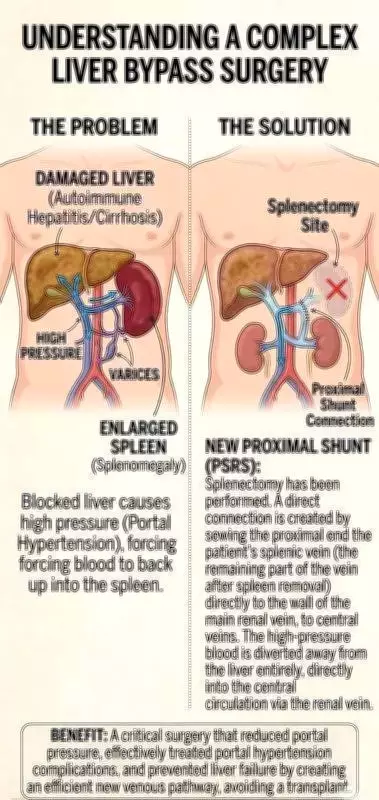
On February 11 this year, a multidisciplinary team led by Dr Santosh Thorat, head of the department of surgery at YCM Hospital and a hepato-pancreato-biliary surgeon, performed a proximal splenorenal shunt (PSRS). Dr Thorat explained that this was a high-stakes operation utilizing advanced micro-vascular techniques to divert blood flow from high-pressure veins to lower-pressure veins.
"Essentially, our surgeons created a new ‘highway' for blood flow," said Dr Thorat. "We also removed the enlarged spleen, allowing her body to finally retain its own blood cells. While the spleen helps the immune system, it's not absolutely needed for survival. Now, its functions will be managed by the liver and other lymphatic tissues."
Dr Thorat used a vivid analogy to describe the medical crisis: "It was like a city facing a riot (internal tissue attack) and a major water main burst (vascular attack) simultaneously. By diverting the blood flow, we reduced the stress on her liver, preserving its function and avoiding a future transplant."
Statistical Rarity and Diagnostic Complexity
The case presented extraordinary diagnostic challenges due to its statistical rarity. Dr Thorat highlighted that the presence of positive IgG, ANA, and ASMA markers within the clinical framework of NCPF makes this case exceptionally uncommon. Such a convergence of autoimmune indicators and portal fibrosis is estimated to occur in fewer than 5% of cases worldwide, underscoring the diagnostic complexity faced by the medical team.
Complete Surgical Success and Rapid Recovery
The surgery proved to be a complete success. Within just three days, the patient's blood counts stabilized naturally for the first time in years—a dramatic turnaround from her previous condition. She has since resumed a normal diet and no longer requires the costly, frequent medical interventions that were previously essential for her survival.
The young woman was discharged on February 26 and is now preparing to return to college, reclaiming her academic life. She will remain on blood-thinning medication (anticoagulants) and undergo annual surveillance to monitor her liver function. Doctors have confirmed that her kidneys remain healthy and unaffected by the condition, providing additional positive news for her long-term prognosis.

Affordable Healthcare Through Government Scheme
Before arriving at the government-run YCM Hospital, the patient's family had consulted several private hospitals where the surgery was estimated to cost between Rs 5 lakh and Rs 10 lakh—a substantial financial burden for most families. At YCM Hospital, the entire life-saving procedure was performed free of charge under the Mahatma Jyotirao Phule Jan Arogya Yojana (MJPJAY) scheme, demonstrating the critical importance of accessible healthcare initiatives.
Multidisciplinary Medical Team Behind the Success
Along with Dr Santosh Thorat, the successful surgery was performed by a dedicated multidisciplinary team comprising:
- Dr Rahul Nikam (plastic and vascular surgeon)
- Dr Anand Zingade (professor of surgery)
- Dr Mayur Bawiskar (associate professor of surgery)
- Dr Dattatray Toradmal
- Dr Aniket Kuldipak
- Dr Aniket Narnavare
This collaborative effort highlights how specialized medical expertise working in concert can achieve extraordinary outcomes even in the most challenging clinical scenarios.





