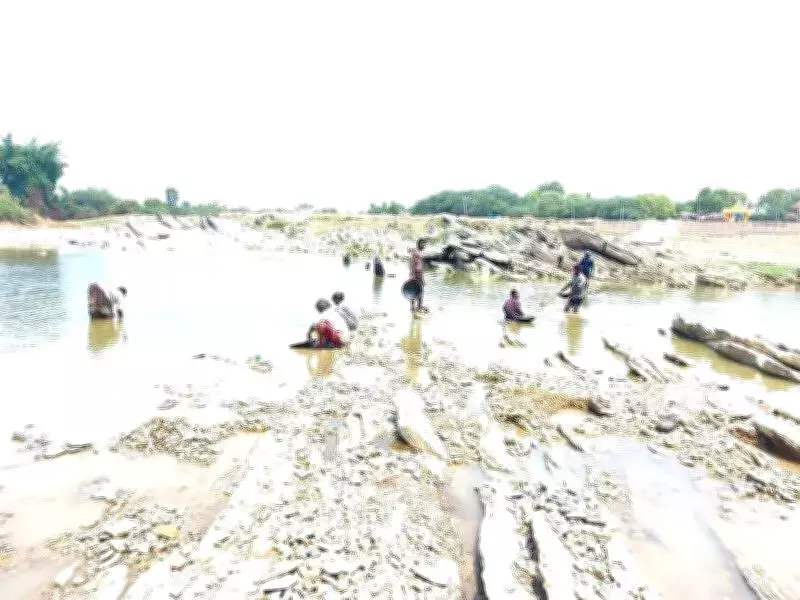
Haveri: Under the harsh summer sun in Haveri, the Varada River, once the lifeline of the district, now lies dry and broken, reduced to scattered pools of water and stretches of exposed black soil and sand.
In these dry riverbeds, a striking scene unfolds. Families from the Irular community in Shivamogga have arrived and begun the painstaking search for tiny gold particles hidden in the soil. Every year, as summer deepens and the river recedes, members of the community return to the Varada.
They set up temporary tents along the riverbank and spend long hours working in the shallow pools. Armed with baskets and simple tools, they scoop up sand mixed with soil from the riverbed and carry it to the water's edge. There, they wash the mixture repeatedly, letting the lighter black soil float away. The sand is then separated carefully until, if fortune allows, a few glittering specks of gold appear at the bottom.

The work is slow, repetitive, and physically exhausting. Entire families take part in the process, spending the day bent over baskets in the heat, driven by the hope that even the smallest trace of gold can bring some income. For them, this is not a matter of adventure or sudden wealth, but survival.
With gold prices soaring far beyond the reach of the poor, the irony is sharp. Those who cannot afford to buy even a gram of gold spend days searching for tiny particles of it in the drying river. Yet, even a speck is valuable enough to matter. The little they collect is sold to local goldsmiths, who pay them modest sums that help sustain their families.
Naganna, one of the workers, says this has been their way of life for generations. "We have been doing this work since our grandfather's time. We come here every year. We set up tents by the riverbank and live here for a month. Then we do labour work in areca and coconut plantations. We search for gold particles in the black soil and sand in the pools of water and sell them. We earn 200 to 300 rupees a day and make a living from it," he says.
In the silent, drying bed of the Varada, their labour reflects both hardship and resilience as they continue an age-old practice in search of a fragile livelihood.
Expert Comment
"I thought this is not original gold, it's just like copper. I will check and inspect," said SG Naveen, senior geologist, Department of Mines and Geology, Haveri.