

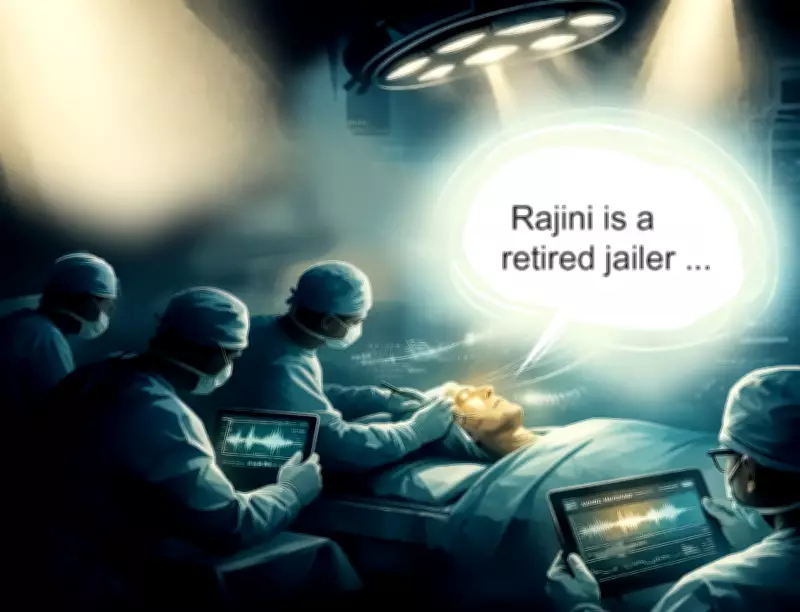
Chennai Neurosurgeons Pioneer Movie Narration Technique During Awake Brain Surgeries
In a remarkable scene at SIMS Hospital in Chennai, a 75-year-old patient undergoing brain surgery passionately narrates a scene from Pradeep Ranganathan's 2025 hit film 'Dude'. The patient's voice fills the operating room while surgeons meticulously work on sections of his skull, demonstrating an innovative approach to preserving neurological function.
Transforming Traditional Brain Mapping with Cinema
Senior neurosurgeon Dr. K R Suresh Babu explains that while it's standard practice to keep some patients awake during tumour resection surgeries, traditional methods involve asking patients to name days of the week, recall family members' names, or identify objects from pictures. "These conventional tasks can exhaust both doctors and patients," says Dr. Babu. "We discovered it's significantly easier to engage patients by having them talk about movies they've seen."
The Chennai-based medical team tested movie narration during 38 awake brain surgeries over three years, with their groundbreaking results published as a letter to the editor in the prestigious journal 'Clinical Neurophysiology Practice'.

Revealing Subtle Cognitive Impairments Through Storytelling
In nine cases—representing nearly 25% of the patients studied—movie narration successfully identified critical neurological issues that traditional methods might have missed. The technique revealed word-finding pauses, character-naming failures, narrative tangents, and subtle grammar slips, prompting surgeons to refine tumour resection near eloquent brain zones responsible for language and cognition.
"Unlike isolated tasks such as counting to ten, movie narration demands real-time integration of comprehension, memory, sequencing, and expressive language through dialogue," Dr. Babu elaborates. "When patients simply count numbers or recite alphabets, we cannot assess their ability to retain intonations or connect narrative incidents."
Personalized Brain Mapping Through Patient Interests
The surgical team employs electrical stimulation on exposed brain areas while patients perform various tasks. If stimulation disrupts a task—causing speech to halt or stammer—it signals an impact on zones controlling language, motor skills, or sensation. "This process is meticulously tailored to each patient and procedure," Dr. Babu emphasizes. "Depending on the tumour's location and the surgery's stage, we may switch between testing language functions and monitoring motor capabilities."
Intraoperative neurophysiologist Dr. Nishanth Sampath reveals that the hospital employs diverse techniques based on patient interests and abilities. "We get musicians to sing or play instruments during surgery, and children to play video games to map motor skills, coordination, and dexterity," says Dr. Sampath. "However, we discovered that most people feel shy about singing but become completely at ease when discussing movies."
Assessing Social Communication and Cognitive Function
Guided story retelling of favorite blockbuster films reveals subtle language slips that allow doctors to screen fluency more effectively than conventional methods. "This approach helps us determine if the surgery is affecting patients' ability to select information, organize thoughts, or adapt their communication," Dr. Sampath explains. "It tests not just basic speech functions but also social communication skills and higher cognitive processes."
The technique did face limitations in four patients who weren't familiar with movies, experienced significant anxiety, or spoke only a few sentences during the procedure. For these individuals, doctors reverted to traditional brain mapping methods to minimize surgical risks.
This innovative approach developed by Chennai neurosurgeons represents a significant advancement in awake craniotomy procedures, potentially improving outcomes for patients undergoing delicate brain tumour resections near critical functional areas.






