

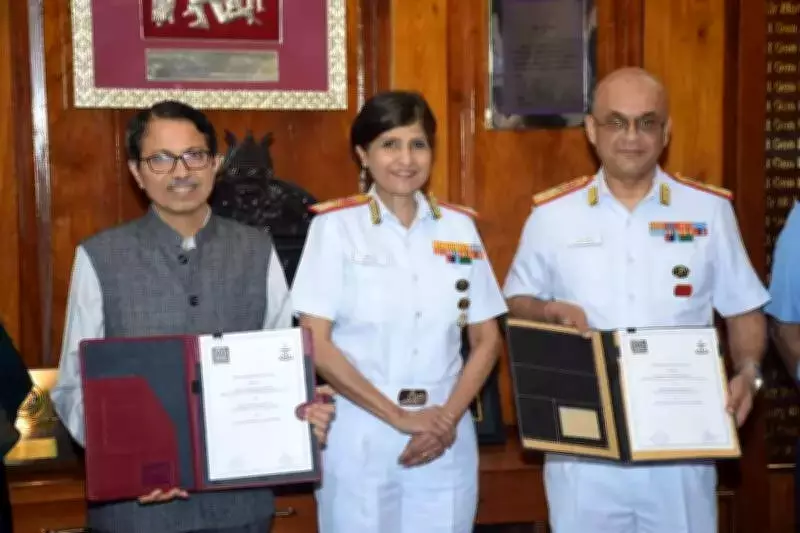
Armed Forces Medical College and IISc Launch Groundbreaking Research Partnership
The Armed Forces Medical College (AFMC) in Pune has entered into a historic memorandum of understanding with the prestigious Indian Institute of Science (IISc) in Bengaluru. This landmark agreement, signed on Thursday, establishes a formal framework for collaborative research aimed at developing advanced medical tools and equipment specifically designed to enhance healthcare delivery for troops stationed in remote and high-risk border regions.
Focus on Combat Medicine and Extreme Environments
This partnership represents the first such initiative undertaken by the Armed Forces Medical Services (AFMS) and will concentrate on creating cutting-edge solutions in the specialized field of combat medicine. The collaboration will address unique challenges faced during military operations in extreme environments where conventional medical approaches often prove inadequate.
Navakanta Bhat, dean of the division of interdisciplinary sciences at IISc, described the collaboration as a "game changer" for military healthcare. "We will jointly work on solutions to improve healthcare delivery in combat scenarios. Research will cover the development of medical tools, equipment, emerging technologies, and contemporary challenges faced by troops in extreme environments," he explained.

Bhat noted that IISc's bioengineering department has already established expertise in niche areas including advanced wound-healing technologies, and this specialized knowledge will now be extended to address defense-specific medical requirements.
Technology-Driven Healthcare Transformation
Vice Admiral Arti Sarin, AFMS Director General, emphasized that the armed forces are increasingly looking to leverage technology to overcome logistical and operational constraints. "We are already planning to use drones for medicine supply in remote locations and to expand telemedicine services across difficult terrains. This MoU is a crucial step in that direction. IISc will provide bioengineering solutions, while our doctors will define real-time operational requirements," she stated.
The agreement includes provisions for AFMS doctors to pursue PhD programs at IISc in the coming years, creating a pipeline of highly qualified medical researchers with specialized knowledge of military healthcare needs.
Institutional Commitment to Innovation
Lt Gen Pankaj Rao, AFMC Commandant, revealed that the institution has already established an innovation cell focused on developing medical tools relevant to military service. "This collaboration will allow our cadets and doctors to work closely with engineering experts to design equipment that directly addresses field requirements. All AFMC departments will work in tandem with IISc faculty members," he affirmed.
Digital Health Infrastructure Expansion
On the broader digital health evolution, Vice Admiral Sarin detailed how AFMS is systematically embracing digital transformation to enhance efficiency, transparency, and quality of care across military medical services.
"We are implementing multiple digital platforms which will create an integrated digital backbone for medical governance. We are also developing a standardized health information management system across all three services. Telemedicine services are being strengthened through an upgraded module with specialist consultations. Our onboarding with the Ayushman Bharat Digital Mission will further enable secure health data integration," she elaborated.
The Vice Admiral added that several telemedicine nodes are already operational, with this network expanding in collaboration with ISRO's space applications center. "Digital health, for us, is not merely about technology — it is about improving access, continuity, and patient-centricity across all terrains and operational environments," she concluded.
The memorandum of understanding was formally signed by Vice Admiral Arti Sarin and senior faculty members of IISc, marking the beginning of what promises to be a transformative partnership in military medical research and innovation.






