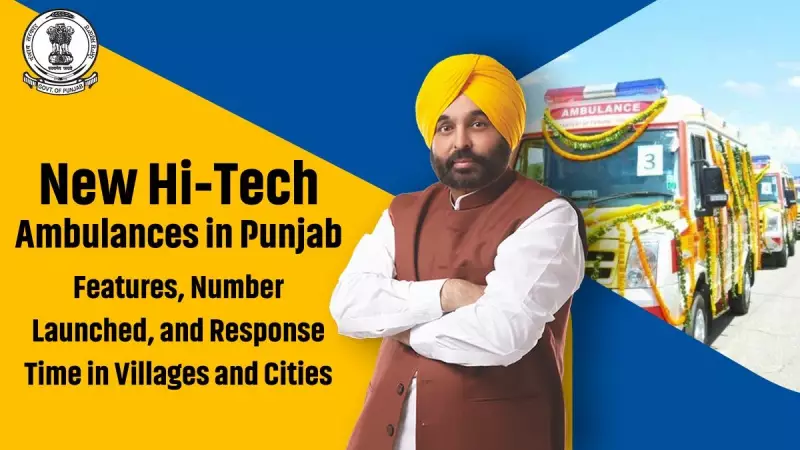
In a significant move to revolutionize emergency medical response, the Punjab government has unveiled a fleet of 100 state-of-the-art ambulances. Chief Minister Bhagwant Mann personally flagged off these advanced life-saving vehicles, marking a new chapter in the state's healthcare infrastructure. The initiative aims to drastically cut down emergency response times, ensuring critical care reaches citizens faster than ever before.
Advanced Features of the New Ambulance Fleet
The newly launched ambulances are a far cry from basic transport vehicles. They are equipped as mobile intensive care units (ICUs), designed to provide critical care en route to the hospital. Each ambulance is fitted with advanced life-support systems, including ventilators and cardiac monitors, allowing paramedics to stabilize patients during transit.
A key technological upgrade is the integration of real-time GPS tracking. This system enables the control room to monitor the exact location of every ambulance, ensuring optimal deployment and the fastest possible routing to an emergency site. The communication systems have also been enhanced for seamless coordination between the ambulance crew, the control center, and the receiving hospital.

Ambitious Targets for Response Time
Chief Minister Bhagwant Mann announced clear and ambitious benchmarks for the service's performance. The government has set a stringent target for the newly launched fleet: to reach any emergency call within 15 minutes in urban areas and within 30 minutes in rural villages.
This initiative directly addresses a critical gap in emergency medical services, particularly in remote areas where access to immediate healthcare is often delayed. By guaranteeing a swift response, the government aims to save countless lives, especially in cases of heart attacks, accidents, and other time-sensitive medical emergencies.
A Boost to the 108 Service and Future Plans
This fleet of 100 hi-tech ambulances will be integrated into the existing 108 ambulance service, significantly augmenting its capacity and technological capability. The launch event, held with much fanfare, underscores the Aam Aadmi Party government's focus on upgrading public health infrastructure.
While the current launch involves 100 vehicles, the government has indicated that this is part of a larger, ongoing effort. The move has been widely welcomed by healthcare professionals and citizens alike, who see it as a vital step towards a more robust and reliable emergency response system across the state of Punjab.
The successful implementation of this service, meeting its promised response times, will set a new standard for emergency medical services in the region and serve as a model for other states to follow.