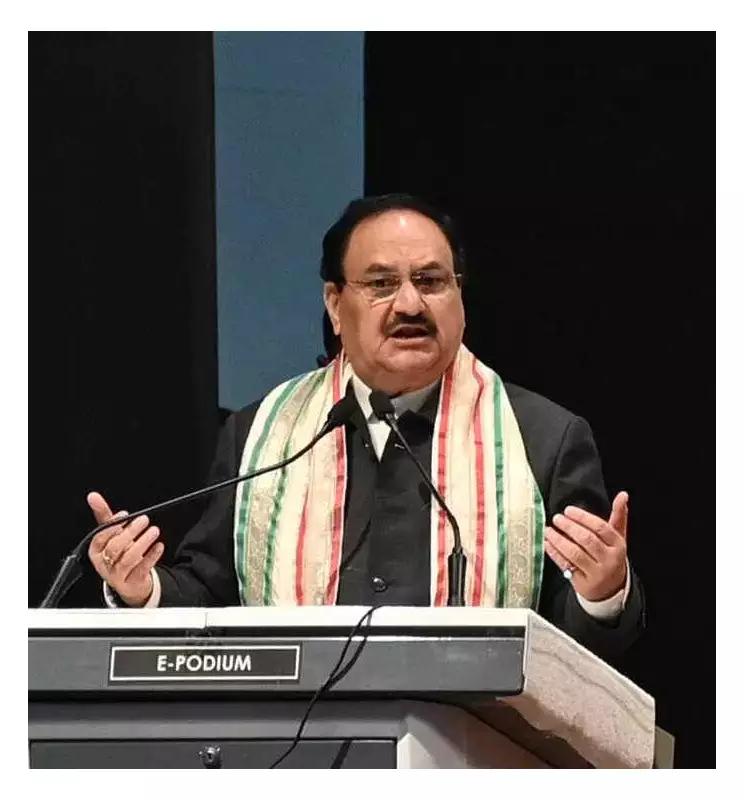
Union Minister for Health and Family Welfare, Jagat Prakash Nadda, declared on Saturday that India's healthcare system has undergone a radical transformation, shifting its focus from serving elite institutions to reaching the most impoverished and vulnerable citizens. He attributed this shift to strong political will, clear policies, and substantial investments in medical education and health infrastructure.
Ayushman Bharat: Removing Financial Barriers for Millions
Addressing the 21st convocation of King George's Medical University (KGMU) in Lucknow, Nadda pointed to the Ayushman Bharat Pradhan Mantri Jan Arogya Yojana as a game-changer. He emphasized that the scheme, which provides an annual health cover of Rs 5 lakh per family, ensures the poorest patients can start treatment immediately without worrying about costs.
He revealed a significant policy win: all citizens above 70 years are now covered under medical insurance, regardless of their income, caste, or religion. This contrasts sharply with private insurers, who typically stop offering policies after 60-65 years of age.

"Today, treatment for serious conditions like cancer often begins within 30 days of detection because we have removed the financial barriers. This is the real, tangible impact of thoughtful policy-making," Nadda stated, calling Ayushman Bharat the world's largest health coverage programme with over 62 crore beneficiaries.
Massive Expansion in Infrastructure and Medical Education
The Minister drew a stark contrast between the past and the present. He recalled that for decades, India had only one All India Institute of Medical Sciences (AIIMS), forcing many aspiring doctors to seek training abroad.
"Today, under the leadership of Prime Minister Narendra Modi, India has 23 AIIMS, all equipped with cutting-edge infrastructure," Nadda announced. He firmly stated that a lack of facilities can no longer be an excuse for Indian doctors to leave the country. "Institutions are here, facilities are here, and opportunities are here," he asserted.
Highlighting the unprecedented expansion in medical education, Nadda shared remarkable figures:
- Number of medical colleges increased from about 387 to over 700.
- Undergraduate (MBBS) seats rose from 50,000 to over 1 lakh.
- Postgraduate (MD/MS) seats jumped from 31,000 to nearly 80,000.
He further announced the government's ambitious target to add 75,000 more medical seats by 2029.
A Call to Compassion and Acknowledgment of Digital Progress
Nadda began his speech by saluting the medical profession, reminding the graduating doctors that treating patients is an extraordinary responsibility. "When a patient comes to you, they place their life in your hands. What seems impossible to the world, doctors make possible every day," he said.
He advised the new graduates to seek validation not in certificates, but in the gratitude of saved patients and their families. "Doctors are silent workers. The biggest certificate is the satisfaction of saving a life," Nadda remarked.
The Minister also praised the unsung heroes of healthcare—the librarians, lab technicians, sanitation workers, drivers, and canteen staff—urging doctors to remember their vital contributions.
Nadda highlighted India's advances in digital health, including robust mother and child tracking systems, vaccination monitoring, and instant digital certificates. "From pregnancy to adolescence, children are tracked for timely vaccination and care. This is Digital India in action," he explained. He noted that India's improvement in key health indicators like the Maternal Mortality Rate (MMR) and Infant Mortality Rate (IMR) has outpaced the global average.
Concluding his address, the Health Minister told KGMU graduates they are entering a dynamic healthcare system with global responsibilities. "India is not only catering to its own healthcare needs but also serving the world. You are part of that strength," he said, expressing confidence that they would uphold the institution's legacy with commitment and empathy.

He also commended KGMU for its 8th rank in the NIRF Rankings 2025 and for having 12 faculty members listed among the world's top 2% scientists.