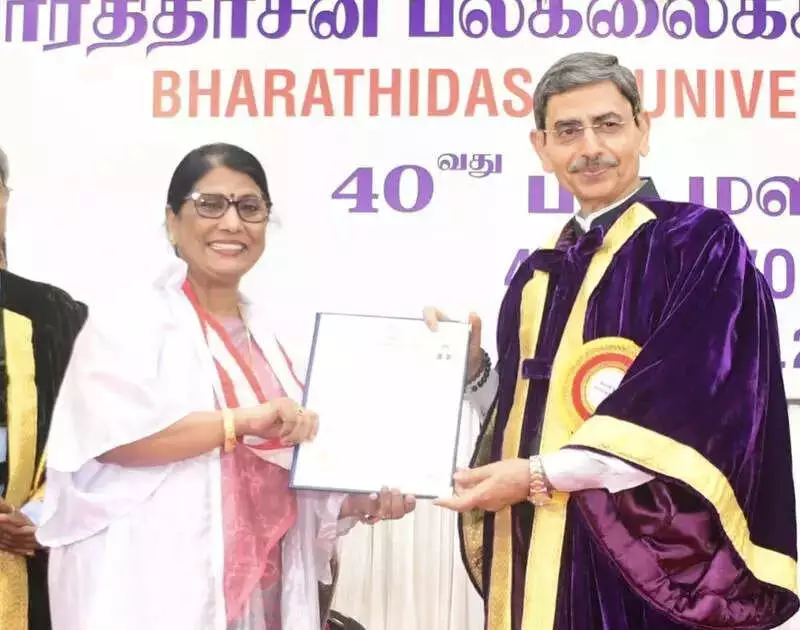
Disturbed by the alarming frequency of suicide cases she encountered throughout her judicial career in various districts, a 61-year-old sitting judge of the Madras High Court, Justice R N Manjula, has achieved a significant academic milestone. She successfully completed her PhD in suicidal behavior and was formally awarded the degree by Governor R N Ravi during Bharathidasan University's prestigious 40th convocation ceremony.
From Courtroom Observations to Academic Inquiry
Justice Manjula's doctoral research focused specifically on "Prevalence of suicidal ideation among students of higher education institutions in Chennai: An analysis from a gender perspective." In an interview, she revealed that her profound interest in this critical subject developed gradually over the past eight to nine years while serving in district courts. During this period, she handled a substantial number of heartbreaking suicide and dowry death cases, which left a lasting impact on her.
Uncovering Family Dynamics and Systemic Issues
"When I meticulously read case histories and examined witnesses during trials, a disturbing pattern became evident," Justice Manjula explained. "Many women in distress had desperately reached out to their families for support, yet often, the family dynamics themselves turned out to be significant contributory factors to their despair." Her research was conducted under the guidance of the Women's Development Centre at Bharathidasan University, providing an academic framework to explore these judicial observations.

The issue of student suicides has gained national prominence recently, particularly after the Supreme Court of India took formal cognizance of multiple tragic incidents occurring at premier educational institutions across the country. While judicial verdicts can address individual legal cases, Justice Manjula felt that a deeper, more nuanced social understanding was urgently required to tackle the root causes. This conviction prompted her to pursue rigorous academic research following her elevation from the district judiciary to the High Court.
Bridging Judicial Authority with Social Science
"As a judge, I possess the authority to deliver judgments and interpret the law," Justice Manjula stated when questioned about her primary motivation. "However, to genuinely understand this complex issue from a societal perspective and contribute to meaningful prevention, I decided to pursue a PhD." This unique journey represents a powerful fusion of legal expertise with psychological and sociological inquiry.
Revealing Research Findings from Chennai
Her comprehensive study involved a substantial sample size of more than 2,000 students across 20 different higher education institutions in Chennai. The findings revealed that approximately 10% of the surveyed students reported experiencing suicidal ideation. Interestingly, and contrary to some stereotypes, the data indicated that men accounted for nearly two-thirds of these reported cases, highlighting important gender-specific vulnerabilities that require targeted intervention strategies.
Justice Manjula's work underscores the critical need for interdisciplinary approaches to mental health crises. By combining her frontline judicial experience with scholarly research, she aims to inform both legal practices and public health policies, advocating for systemic changes that address the underlying social and familial factors contributing to suicidal behavior among India's youth.