

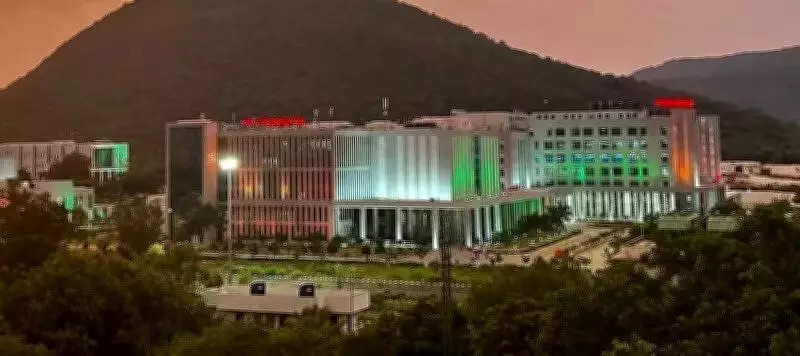
AIIMS Mangalagiri Grapples with Critical Staff Shortages as Patient Numbers Skyrocket
In Vijayawada, the All India Institute of Medical Sciences (AIIMS), Mangalagiri, a premier central medical institute serving the Central Andhra region, is confronting a severe staff shortage that is hampering its operations. This crisis unfolds against a backdrop of an overwhelming patient influx, with the institute handling an average of 3,500 outpatients daily, a figure that frequently exceeds 4,000 on peak days. Over the years, AIIMS Mangalagiri has established itself as a vital healthcare hub, catering to over 30 lakh outpatients not only from Andhra Pradesh but also from neighboring states, highlighting its regional importance.
Exponential Growth in Patient Services
The institute has witnessed a staggering 835% growth in outpatient department (OPD) services, escalating from 84,235 OPD patients in 2019 to an impressive 8.46 lakh OPD patients in 2025. This surge underscores the increasing reliance on public healthcare facilities in the area. Additionally, in the previous year, a total of 26,310 patients received in-patient services, further emphasizing the high demand for medical care at this institution.
Impact of Staff Shortages on Bed Capacity and Services
Due to the acute staff shortage, AIIMS Mangalagiri is currently operating only around 650 beds on a full-fledged basis, significantly below the 960 beds that have been officially sanctioned. This deficit forces many patients in need of emergency and other critical healthcare services to turn to private hospitals in the region, potentially increasing out-of-pocket expenses and reducing access to affordable care.

Official data reveals that several key departments are non-functional due to unfilled staff positions. Specifically, the medical gastroenterology and surgical gastroenterology departments, along with rheumatology and neonatology, are not operating as recruitment in these areas has not been completed. An anonymous official noted, "Despite staff unavailability in neonatology, doctors from paediatrics and paediatric surgery are attending to emergency and critical cases in neonatology at the hospital." This stopgap measure highlights the strain on existing resources.
Recruitment Challenges and Salary Concerns
The institute has issued multiple notifications to fill vacant posts across various departments but has received only a mediocre response. The official explained, "Doctors feel that the salaries paid to them at AIIMS hospitals are non-remunerative, as they can earn double and triple in salaries practising at private hospitals compared to what they are paid in AIIMS." This disparity in compensation is a significant barrier to attracting and retaining qualified medical professionals, exacerbating the staffing crisis.
Efforts to Address the Crisis
In response to these challenges, AIIMS Mangalagiri executive director Professor Dr. Ahanthem Santa Singh provided insights into the institute's efforts. He stated, "As the patient footfall increases by the day, we are working to augment the bed capacity gradually to meet the rising demand. Currently, there are 650 functioning beds, a 10X growth rate when compared to just 50 functional beds in 2020. Of the 650 functional beds, the hospital has 88 ICU beds." This represents a substantial improvement from earlier years, yet it falls short of the sanctioned capacity.
Dr. Singh further announced plans to recruit at least 50 professor posts soon to address vacancies and alleviate staff shortages in various super speciality departments. This initiative aims to enhance the hospital's ability to provide comprehensive healthcare services and reduce dependency on private facilities.
Broader Implications for Healthcare in Andhra Pradesh
The situation at AIIMS Mangalagiri reflects broader issues in public healthcare infrastructure, where staffing gaps can lead to reduced service availability and increased patient burdens. With the institute serving as a critical resource for millions, resolving these shortages is imperative to ensure accessible and quality medical care for the population of Andhra Pradesh and beyond. Continued efforts in recruitment and potential salary revisions may be necessary to attract talent and stabilize operations in the face of growing healthcare demands.






