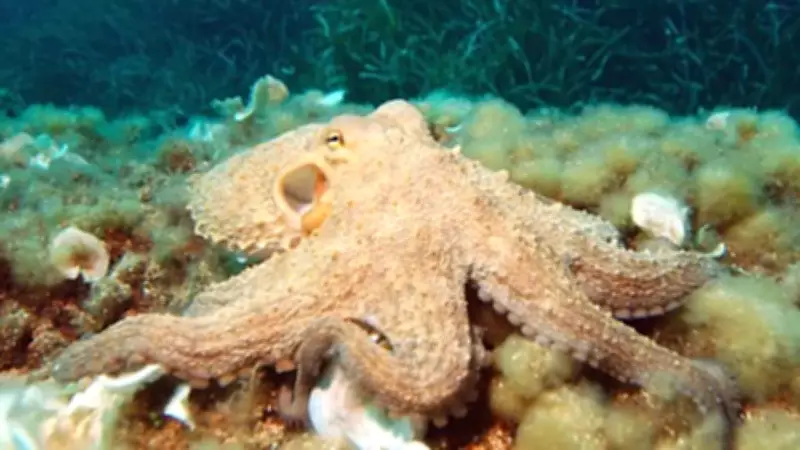
Octopuses Discovered Using 'Taste by Touch' to Locate Mates in Pitch-Black Ocean Depths
In the profound darkness of the deep sea, where visual perception is severely limited, the challenge of finding a reproductive partner becomes a significant obstacle. Octopuses, renowned for their remarkable intelligence and typically solitary, antisocial nature, encounter each other infrequently. This scarcity of social interaction consequently makes the process of reproduction considerably more difficult for these cephalopods. However, a groundbreaking scientific discovery has now illuminated a surprising solution to this reproductive dilemma, revealing an extraordinary adaptation in octopus behavior.
Chemical Detection Replaces Vision in Octopus Mating Rituals
Unlike the majority of other marine creatures, octopuses have evolved to utilize an incredibly sophisticated sensory system to overcome the limitations of their environment. Research indicates that these animals rely on their acute sense of touch combined with taste to pick up chemical signals emitted by potential mates. This process, termed "taste by touch," allows octopuses to identify and engage with partners entirely without the need for visual confirmation. The mating procedure in octopuses does not involve vision as a primary means of mate identification. Instead, the creatures employ their limbs to detect specific chemicals released by prospective partners, facilitating reproduction in complete darkness.
Hectocotylus Arm: A Dual-Purpose Organ for Sensing and Reproduction
According to the seminal study titled 'A sensory system for mating in octopus,' published in the prestigious Science journal, male octopuses possess a specialized arm known as the hectocotylus. This unique organ plays a dual role: it is essential for transferring sperm to the female, and it functions as a highly sensitive sensory device. The hectocotylus is equipped with specialized receptors that enable the male octopus to detect progesterone and other sex-related chemicals produced by females. This means that mating can occur successfully even when the two individuals cannot see each other, relying solely on chemical communication through touch.

Experimental Evidence: Mating Through Barriers Without Visual Contact
To validate this discovery, researchers conducted controlled experiments involving male and female octopuses separated by a barrier with small openings. Remarkably, without any visual access to the female, the male octopus was able to locate her by inserting its arms through the openings. Using its sensory capabilities, the male detected the female's chemical cues and proceeded to mate, with interactions lasting over an hour in multiple instances. This experimental setup clearly demonstrated that octopuses can effectively find and mate with partners relying exclusively on non-visual senses, highlighting the efficacy of their "taste by touch" mechanism.
Sophisticated Arm Functionality as Advanced Sensory Organs
The arms of an octopus are not merely limbs for movement; they are extremely sophisticated structures that operate almost independently as sensory organs. These arms are densely packed with numerous receptors that allow the octopus to interact with, taste, and sense its surroundings in intricate detail. A significant portion of the octopus's nervous system is distributed throughout its arms, enabling them to respond to stimuli and process sensory information without direct impulses from the central brain. This decentralized nervous architecture is precisely what facilitates their unique mating ritual, allowing for rapid, localized decision-making based on chemical detection.

Evolutionary Significance and Insights into Octopus Intelligence
The importance of this finding extends beyond mere behavioral observation; it underscores a fascinating aspect of evolutionary biology. Evolution has ingeniously combined multiple functionalities within a single organ—the hectocotylus arm not only serves a reproductive purpose by delivering sperm but also acts as a chemical sensor, enhancing mating efficiency in environments where encounters are rare. This dual functionality exemplifies nature's capacity to develop highly effective systems tailored to specific ecological challenges. While the intelligence of octopuses has long been acknowledged, this discovery adds a new dimension to our understanding of their biological efficiency. The integration of sensory and reproductive skills demonstrates how the species has adapted to thrive and reproduce in conditions where visual senses are rendered useless, such as the lightless depths of the ocean.
This revelation about octopus mating behavior not only enriches our knowledge of marine biology but also prompts further inquiry into the adaptive strategies of other deep-sea organisms. It highlights the incredible versatility of life in overcoming environmental constraints through innovative sensory and reproductive adaptations.