New TB Vaccines Show Promising Results in India's Battle Against High Disease Burden
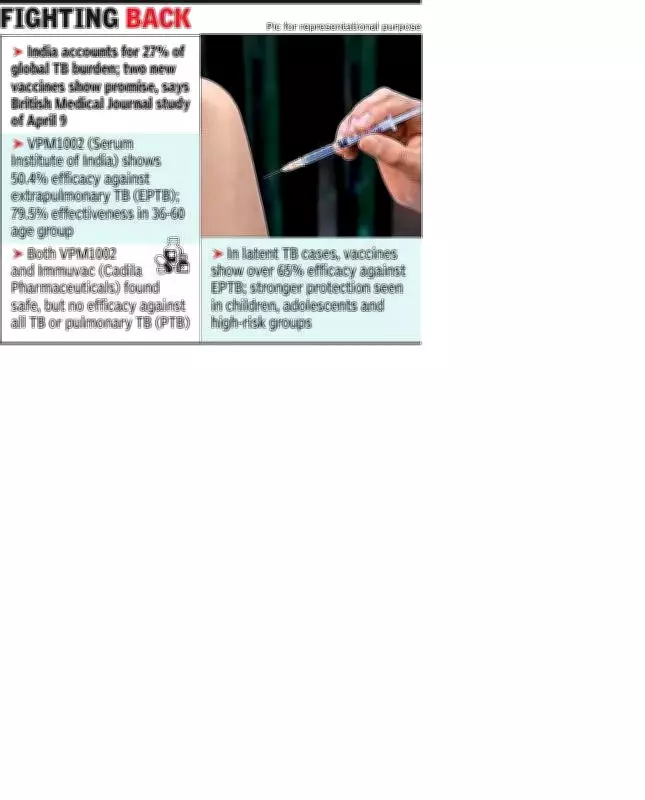
In a significant development for public health, two new vaccines have demonstrated promising results amid India's ongoing struggle with the world's highest burden of tuberculosis (TB), which stands at 27%. A comprehensive study published in the British Medical Journal (BMJ) on April 9 has detailed the efficacy of these two novel vaccines—VPM1002, developed by the Serum Institute of India in Pune, and Immuvac, manufactured by Cadila Pharmaceuticals Ltd—in tackling this persistent health challenge.
Vaccine Efficacy Against Extrapulmonary TB
The study revealed that VPM1002, a genetically modified recombinant Bacillus Calmette-Guérin (BCG) vaccine, displayed 50.4% effectiveness against extrapulmonary TB (EPTB) across all age groups. Notably, vaccine effectiveness reached 79.5% among individuals aged 36 to 60 years, suggesting a potentially major public health benefit. Extrapulmonary TB accounts for approximately 22% of total TB cases reported in India, affecting not only the lungs but also other organs such as lymph nodes, pleura, abdomen, and spine.
This condition presents significant diagnostic challenges due to its paucibacillary nature, meaning the presence of very few bacteria in the body, despite advanced diagnostics like Xpert MTB/RIF. EPTB is associated with high morbidity because of difficulties in both diagnosis and treatment, making effective vaccines particularly crucial.

Current Vaccine Landscape and Study Findings
Currently, BCG is the only licensed vaccine against TB. While it is effective against severe forms of the disease in young children, it does not offer protection to adolescents and adults. The recent study included vulnerable household contacts aged around 6 years and above, irrespective of comorbidities and risk factors, providing a broad assessment of vaccine performance.
The BMJ study found that both VPM1002 and Immuvac are safe, but they did not show any efficacy against all forms of microbiologically confirmed TB or pulmonary TB (PTB). However, the vaccines demonstrated over 65% efficacy against EPTB in people with latent TB infection—specifically, 64.9% for VPM1002 and 66.3% for Immuvac.
Protective Efficacy in Younger Populations
Another key finding from the research is the protective efficacy in children and adolescents against both PTB and EPTB. VPM1002 showed over 60% protective efficacy against all TB, PTB, and EPTB in the 6 to 14 years age group. Immuvac provided over 60% vaccine efficacy against EPTB only in children aged between 6 and 10 years. These results indicate stronger benefits in high-risk and younger populations, which could be pivotal for early intervention strategies.
However, neither vaccine protected underweight children and adults, suggesting that nutritional support may be needed alongside vaccination, especially for younger children. This highlights the importance of a holistic approach to TB control that includes addressing malnutrition.
Prevention of Progression to Active TB
While neither vaccine offered general protection against TB or prevented latent TB infection, both demonstrated an ability to prevent the progression to active TB in those who developed latent TB at 6 months. VPM1002 provided around 60% efficacy against all TB, PTB, and EPTB, while Immuvac provided about 50% efficacy against all TB and EPTB. This finding is significant as it targets a critical stage in the disease's development.
Expert Insights and Broader Strategy
The study was led by researchers including Manjula Singh of the Indian Council of Medical Research, along with Randeep Guleria, Rohit Sarin, Sindhu Joshi, Sanghamitra Pati, and others. Meanwhile, public healthcare advocate Dr. Anant Phadke emphasized that these vaccines could be useful in the broader strategy of controlling and eliminating TB in India.
"According to the study, it gives protection to around 50% of children aged 5 to 18 who are not malnourished and are household contacts of sputum-positive TB patients. Improving nutrition and housing must be the mainstay of TB control and elimination," he added, underscoring the need for integrated public health measures beyond vaccination alone.

This research marks a hopeful step forward in India's fight against tuberculosis, offering new tools that, when combined with nutritional and housing improvements, could significantly reduce the disease's burden and move the nation closer to its elimination goals.