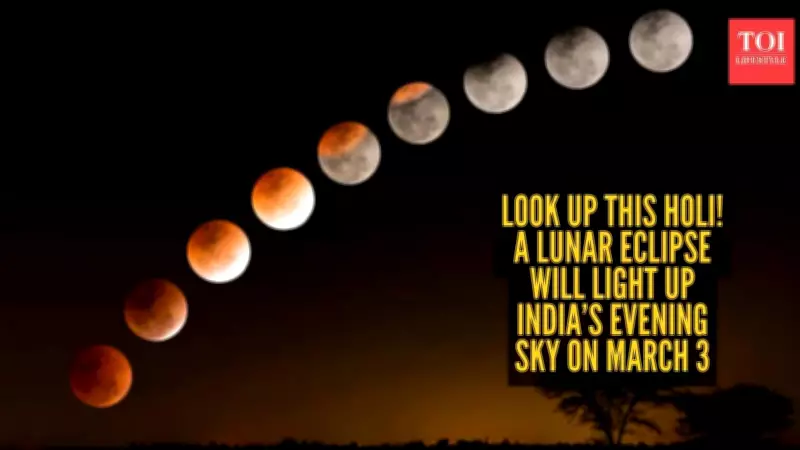
Holi 2026 to Feature Rare Partial Lunar Eclipse in Indian Skies
This Holi, as vibrant colors fill the air, a quieter but equally captivating spectacle will unfold overhead. On March 3, 2026, a partial lunar eclipse will grace the evening sky, offering a brief yet beautiful celestial show for parts of India. While the event will be short-lived and subtle, it adds a unique dimension to the festive celebrations.
A Global Event with a Local Twist
Globally, a total lunar eclipse is scheduled for the same day. However, for observers in India, the timing presents a challenge. The eclipse begins before the Moon rises, meaning that by the time it becomes visible at sunset, the event will already be in its concluding phase. What Indian skywatchers will witness is the final act—a partially shadowed Moon ascending into the evening sky.
Viewing Details Across India
The visibility and duration of the eclipse will vary significantly across the country:

- Eastern and North-Eastern India: These regions are poised for a slightly better view, as the Moon rises earlier while the eclipse is still more pronounced. Cities like Kolkata and Guwahati may experience a longer window to observe the phenomenon.
- Central and Southern India: In areas such as Pune, Nagpur, and Chennai, the experience will be shorter and more delicate. The visible phase may last only 20 to 30 minutes before the Moon fully brightens again. Residents should look toward the eastern horizon just after sunset, where the Moon might appear slightly darker on one side, akin to a gentle bite taken out of it.
Given the fleeting nature of the eclipse, distractions like Holi sweets or festivities could easily cause one to miss it entirely.
The Science Behind the Spectacle
A lunar eclipse occurs when Earth positions itself directly between the Sun and the Moon, casting its shadow onto the lunar surface. The alignment determines the type of eclipse:
- Total Lunar Eclipse: The Moon passes entirely into Earth's umbra (darkest shadow), often turning a coppery red.
- Partial Lunar Eclipse: Only a portion of the Moon enters the umbra, resulting in a shadow that slides across its surface before fading away—exactly what India will experience in 2026.
This partial eclipse happens because the alignment isn't perfect, allowing only part of the Moon to be obscured by Earth's shadow.
How to Watch Safely and Simply
One of the advantages of lunar eclipses is their accessibility. Unlike solar eclipses, they require no special equipment:
- No Glasses or Telescopes Needed: The event is completely safe to observe with the naked eye.
- Minimal Planning: Simply find an open area with a clear view of the sky and hope for favorable weather conditions.
A Memorable Contrast to Holi Festivities
Holi evenings are typically filled with exuberant colors, laughter, and noise. This partial lunar eclipse offers a serene counterpoint—a soft, shadowy spectacle unfolding silently above the celebrations. It serves as a reminder of the natural wonders that accompany our cultural traditions, encouraging people to pause and look up, even if just for a few minutes.
Short, subtle, and easy to miss, this celestial event is nonetheless worth stepping outside for, adding a touch of cosmic magic to the Holi festivities of 2026.