Haryana's Maternal Healthcare Landscape Reveals Stark Urban-Rural Divide
At first glance, Haryana's maternal healthcare statistics present a picture of robust progress, with institutional delivery rates reaching an impressive 98.7% in 2025. However, a deeper examination of district-level data uncovers a concerning trend: the state's most urbanized districts, Gurgaon and Faridabad, are significantly dragging down the share of births occurring in public-sector facilities. This disparity highlights a growing divide in healthcare access and affordability across Haryana's diverse regions.
The Statewide Picture: Strong Numbers Mask Underlying Imbalances
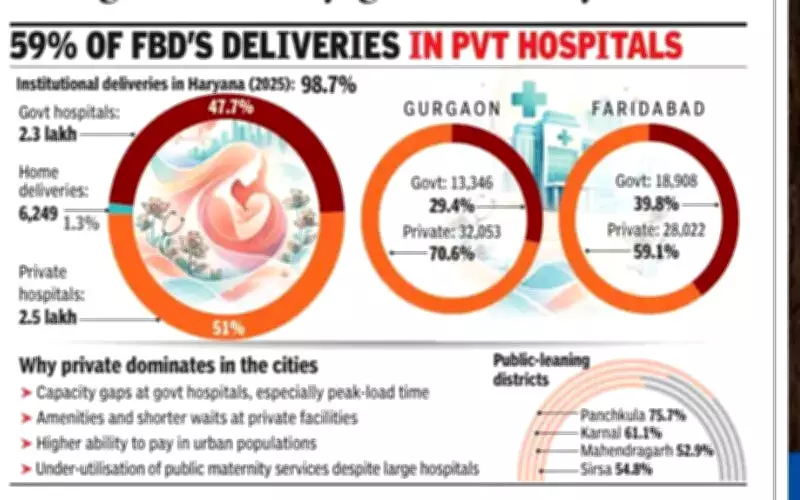
In 2025, Haryana recorded a total of 490,249 births, with the overwhelming majority—98.7%—taking place in health facilities. Government hospitals handled 234,000 deliveries, accounting for 47.7% of the total, while private hospitals conducted 250,000 births, representing 51%. Although home births constituted a small share at 1.3%, they still amounted to 6,249 cases, indicating that traditional delivery methods persist despite extensive institutional delivery programs.
Gurgaon and Faridabad: Private Sector Dominance in Urban Centers
The district-wise breakdown reveals a stark contrast. In Gurgaon, only 29.4% of deliveries occurred in government hospitals, totaling 13,346 births, while a substantial 70.6% took place in private facilities, amounting to 32,053 cases. Faridabad exhibited a similar pattern, with 39.8% of births in public hospitals (18,908 cases) and 59.1% in private institutions (28,022).

This means private hospitals managed approximately seven out of every ten births in Gurgaon, significantly pulling down Haryana's overall government facility share. Health officials attribute this dominance to several factors, including a dense network of private hospitals, perceived superior amenities, and higher out-of-pocket payment capacity among urban families in these affluent districts.
Contrasting Realities: Public Hospitals Thrive in Other Districts
In sharp contrast to Gurgaon and Faridabad, several other districts in Haryana demonstrate a strong reliance on public healthcare facilities for childbirth. Panchkula leads with 75.7% of births in government hospitals, followed by Karnal at 61.1%, Mahendragarh at 52.9%, and Sirsa at 54.8%. These figures indicate a more balanced or public-leaning maternal healthcare system outside the state's major urban centers, where government hospitals remain the primary choice for delivery.
Underlying Challenges: Capacity Constraints and Equity Concerns
Public health experts warn that the private-sector skew in Gurgaon and Faridabad signals under-utilization of government maternity services in districts that host some of Haryana's busiest public hospitals. This imbalance can exacerbate inequities in access and affordability, particularly for lower-income families who may struggle with the high costs of private care.
In Gurgaon, persistent capacity constraints in the public system contribute to this trend. Doctors and patients at the Sector 10 Civil Hospital have long highlighted space and staffing shortages. A notable incident in mid-2023 involved a 26-year-old woman delivering on a corridor floor outside the delivery room after labor pains began en route to the ward, prompting a departmental inquiry and staff reshuffle.
Medical professionals at the Sector 10 hospital report that the facility often operates well beyond its sanctioned bed capacity, especially during peak delivery periods. This overcrowding squeezes referrals, postnatal care, and privacy, factors that push families toward private facilities even for routine births.
Persistent Home Deliveries: A Remaining Challenge
Despite high institutional delivery rates, home births have not been entirely eliminated. Faridabad alone reported 522 home deliveries in 2025, while Palwal logged 1,296, among the highest in the state. Statewide, over 6,000 women still gave birth at home, despite long-running maternal health initiatives.

Specialists emphasize that even small percentages translate into significant absolute numbers, often linked to migrant communities, informal settlements, interrupted antenatal follow-up, or late arrivals at healthcare facilities. These cases underscore ongoing challenges in reaching vulnerable populations with consistent maternal care.
Official Concerns: Confidence in Public Care at Stake
A senior health official expressed worry over the trends in Gurgaon and Faridabad, stating, "When most districts show strong reliance on govt hospitals, Gurgaon and Faridabad's numbers are concerning. It's not just about infrastructure—it's about confidence in public care." As Haryana maintains high overall institutional delivery rates, its most urbanized districts are becoming increasingly dependent on private healthcare, raising difficult questions about equity, out-of-pocket expenses, and the long-term capacity of the public system to anchor maternal care amid growing and urbanizing populations.
The data underscores a critical need for targeted interventions to strengthen public maternity services in urban centers, ensuring that all women, regardless of socioeconomic status or location, have access to safe, affordable, and dignified childbirth options. Addressing these disparities will be essential for achieving equitable maternal healthcare outcomes across Haryana.