

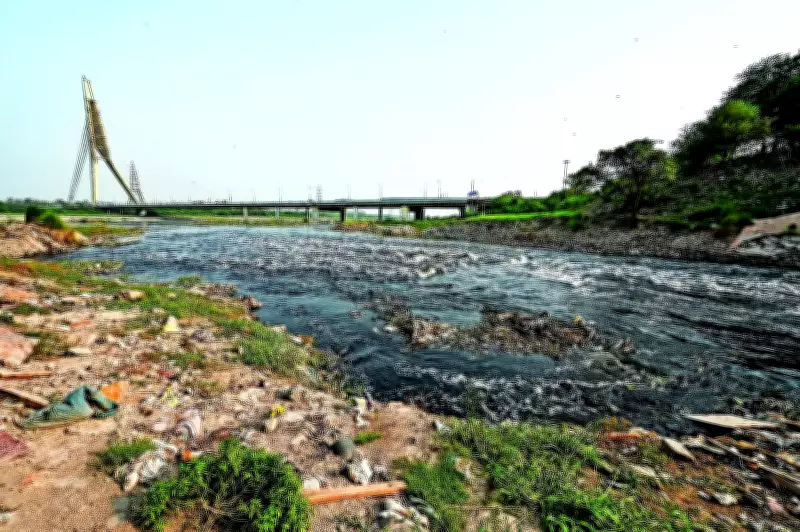
New Delhi: With every flush in Delhi begins a long underground journey. In theory, sewage travels through sewers, reaches pumping stations, is treated at sewage treatment plants (STPs), and only then is safely discharged or reused. In reality, large volumes of untreated or partially treated waste still find their way into the Yamuna through stormwater drains, broken networks, and illegal dumping.
Though recent Delhi Pollution Control Committee data shows some improvement in river water quality compared with last year, the river's fecal coliform levels — a key indicator of sewage contamination from human excreta — remain alarming: up to 620 times above the desired limit and 124 times higher than standards prescribed for outdoor bathing.
How Delhi's Sewage System Works
Delhi currently has an installed sewage treatment capacity of about 814 million gallons per day (MGD), while sewage generation has crossed 992 MGD, according to activists citing Economic Survey estimates. Even if the city achieves planned expansion to 964.5 MGD by December, experts say treatment alone will not solve the crisis.

The city's sewage is supposed to move through underground sewer lines into sewage pumping stations (SPS), from where it is diverted to STPs. At these plants, sewage undergoes screening, sedimentation, biological treatment, and disinfection before treated water is released into drains or reused. But the system leaks at nearly every stage.
Unaccounted Sewage and Leaks
“The main thing is that you are not capturing all the sewage, so some of it escapes the sewerage network,” said Professor A K Gosain of IIT-Delhi, pointing to unauthorised colonies and unsewered pockets where waste directly enters drains. He said ageing infrastructure is another major problem. “There are networks where some sewer lines were intentionally punctured earlier to relieve choking. Unless you desilt and repair them, sewage will keep leaking into natural drains,” he explained.
According to Gosain, Delhi's rapid vertical expansion — old houses replaced by multi-storey apartments — has sharply increased sewage generation without matching infrastructure upgrades. “Water supply, sewage handling, and stormwater systems are interconnected. They must be tackled together,” he added.
Septic Tank Waste and Untreated Drains
Activist Pankaj Kumar of Earth Warriors, a social enterprise, said large gaps remain outside the formal sewer network in Delhi. In several peripheral areas, including parts of Jaitpur and Kalindi Kunj, households still rely on septic tanks because sewer lines don't exist. Recently, the National Green Tribunal (NGT) ordered GPS tracking for tankers carrying septic waste. The problem, Kumar said, is what happens next. “Delhi doesn't have fecal sludge treatment plants (FSTPs). Septage collected by tankers is often dumped illegally into stormwater drains or canals, and that is how it reaches the Yamuna,” he said.
Kumar also questioned the functioning of existing STPs. “They do not always operate properly. Even UV disinfection systems do not guarantee that bacterial contamination won't be back once the treated water enters the drains,” he said. The result is a river that continues to carry the burden of a city whose sewage network remains incomplete, overloaded, and leaking despite decades of expansion.
You can also check: Gold Rate in Delhi | Silver Rate in Delhi | Bank Holidays in Delhi | Public Holidays in Delhi | Delhi AQI | Weather in Delhi
About the Author
Kushagra Dixit writes on environmental issues, wildlife conservation, climate change, agriculture, human rights, and scientific research. His investigative coverage encompasses river contamination with emphasis on the Yamuna, air pollution, urban waste, and their collective effects on public wellbeing.






