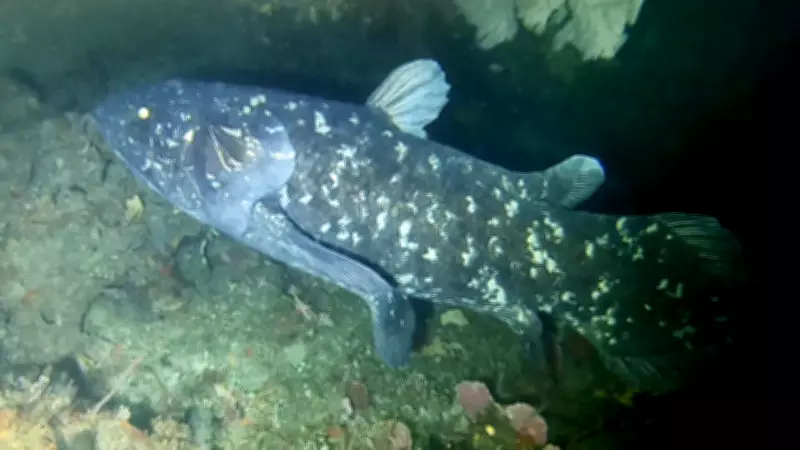
Coelacanth: The Living Fossil Fish That Defied 66 Million Years of Extinction
Imagine hauling in your fishing net after a long day at sea, only to find a bizarre creature staring back at you—one that appears to have swum straight out of a dinosaur-era fossil. This exact scenario unfolded in 1938, leading to the rediscovery of the coelacanth, a fish that had been declared extinct for 66 million years. This "living fossil" has since captivated scientists and serves as a powerful reminder of nature's hidden mysteries.
From Extinct to Alive: The Dramatic Rediscovery
According to a paper published in Nature, the coelacanth's remarkable comeback began on December 23, 1938. Captain Hendrik Goosen's trawler, Nerine, hauled up an unusual fish near the Chalumna River (now Tyolomnqa) in South Africa. Museum curator Marjorie Courtenay-Latimer noticed it among the bycatch, noting its blue-grey body, thick scales, and limb-like fins that didn't match any known species. She sketched the fish and sent the drawing to ichthyologist J.L.B. Smith at Rhodes University.
Smith immediately identified it as a coelacanth, a fish previously known only from fossils dating back over 400 million years, with the last ones vanishing around 66 million years ago alongside the dinosaurs. "There was not a shadow of doubt," Smith later wrote. "It could have been one of those creatures from 200 million years ago come alive again." He named it Latimeria chalumnae in honor of Courtenay-Latimer and the river.

Although the initial specimen was stuffed and ruined for study, the discovery ignited global excitement. Smith even offered a reward for another catch, leading to a second coelacanth being found in 1952 off the Comoro Islands.
Anatomy of a Survivor: Features of a Living Fossil
Coelacanths earn their "living fossil" title due to their unchanged morphology since the Devonian period, over 410 million years ago. Adults can grow up to 2 meters long and weigh as much as 90 kg, featuring a rounded body, broad head, and three-lobed tail. Their most striking characteristic is their lobed fins with bony stalks, which resemble early tetrapod limbs and hint at evolutionary links between fish and land animals.
These fish dwell in rocky caves at depths of 150 to 700 meters, emerging at night to hunt fish, squid, and eels. A low metabolism allows them to survive on minimal food, and they may live up to 100 years. Females give live birth to pups after a gestation period of over a year, a rarity among fish.
Genome studies reveal extremely slow evolution. Researchers sequencing Latimeria chalumnae and L. menadoensis found minimal genetic divergence (0.18%), with heterozygosity rates as low as 0.0019% in Comoro individuals—far below humans' 0.069%. "The rates of heterozygosity of the coelacanth individuals from Tanzania, Comoros, and Indonesia were estimated to be 0.0023%–0.0024%, 0.0019%, and 0.0061%, respectively," noted a study on Britannica, indicating small populations and sluggish mutation rates. Limb-related genes like bmp7 and gli3 enhancers are conserved between coelacanths and tetrapods, absent in ray-finned fish, suggesting ancient origins for land-walking traits.
Two Remaining Species: African and Indonesian Coelacanths
As per a study published in the National Library of Medicine, only two coelacanth species remain today:

- The African coelacanth (Latimeria chalumnae) found in the Western Indian Ocean, including Comoros, Tanzania, Madagascar, Mozambique, Kenya, and South Africa's Sodwana Bay.
- The Indonesian coelacanth (L. menadoensis) discovered in 1998 around Sulawesi, extending the species' range.
Genetic studies have identified distinct populations, such as those in Tanzania differing from those in Comoros. Recent environmental DNA (eDNA) research has confirmed habitats. In 2022, researchers collected samples from Jesser Canyon on South Africa's Sodwana Bay coast using remotely operated vehicles (ROVs) and CTD bottles. Coelacanth eDNA was detected in three of 15 samples, including one 5 km south where none were expected. "Coelacanth eDNA was detected from three of 15 samples collected," concluded a Biology Letters study, confirming the test's specificity with primers Lati602F and Lati776R. Two samples were validated by ROV video footage of four individuals, demonstrating eDNA's effectiveness for hard-to-detect species. This method could enhance distribution mapping, crucial as both species are critically endangered due to gillnet bycatch.
Conservation Challenges: Protecting a Prehistoric Fish
Bycatch poses a significant threat to coelacanths, particularly in Tanzania and Madagascar. With possibly only hundreds of individuals remaining and a low reproduction rate, conservation efforts are challenging. Bottlenecks are evident in Comoro Island populations, reflected in low genetic diversity.
eDNA offers hope for monitoring. "Targeted eDNA sampling could potentially prove to be an effective and flexible approach to increase the rate and resolution at which coelacanth populations are surveyed and tracked," according to a Royal Society study. Genomic knowledge underscores the urgency of conservation; the coelacanth's low substitution rate explains its lack of change but also its vulnerability.
As Smith wrote in his book, a U.S. scientist remarked after the discovery: "Now I can die happy for I have lived to see the great American public excited about fish." Protecting cave habitats and reducing gillnet use are essential steps. This living fossil, resurrected from 66 million years of presumed extinction, showcases remarkable resilience but now relies on human intervention to ensure its survival.