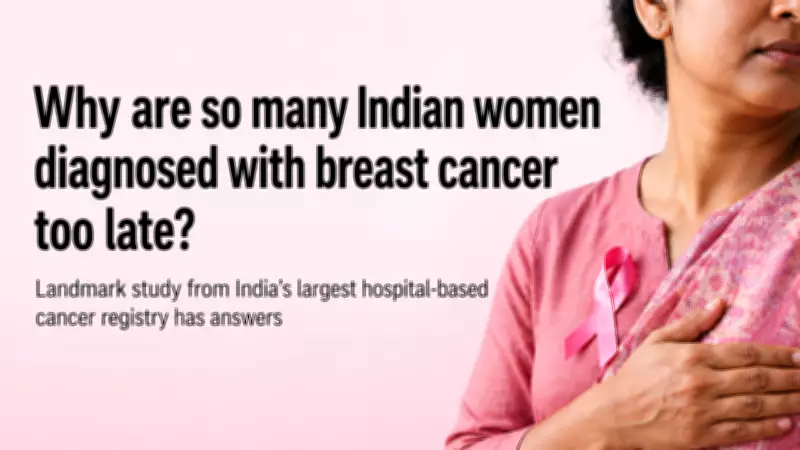
When a woman walks into a hospital with breast cancer that has already spread to other parts of her body, doctors call it de novo metastatic disease. She did not develop metastasis over time; she arrived with it. According to one of the largest hospital-based analyses of breast cancer ever conducted in India, this is happening at nearly twice the rate seen in wealthy countries, and the reasons why reveal important insights about both cancer biology and the Indian healthcare system.
Study Overview and Key Findings
The study, drawn from the Hospital-Based Cancer Registry dataset of the National Cancer Registry Programme, examined over 76,000 breast cancer patients across multiple hospitals in India. It found that nearly 13% of women presented with metastatic breast cancer at the time of diagnosis. In the United States, that figure sits at roughly 6%. This gap, quiet, persistent, and devastating, is what the research set out to understand.
It Is Not About Age; It Is About the Tumour
One of the more striking findings is what the study ruled out. Age turned out not to be a significant predictor of whether a woman presented with metastatic disease. Neither did comorbidities like diabetes or hypertension, at least not in most cases. What predicted metastasis, overwhelmingly, was the tumour itself: how big it was, how aggressive, and how far it had already crept into the body's lymphatic system by the time anyone found it.

Tumours larger than 3 centimetres, higher tumour grade, the presence of lympho-vascular invasion (meaning cancer cells that had already entered the blood or lymph vessels), and involvement of the axillary or supraclavicular lymph nodes were all strongly associated with metastatic presentation. A machine learning model used in the study, called Random Forest, independently confirmed the same factors as top predictors. The message is consistent: the cancer's own biology, its size and aggression, is the primary driver of whether it has spread by the time it is found.
How Breast Cancer Spreads
Dr. Geeta Kadayaprath, Principal Lead at Apollo Athenaa Women Cancer Centre, explains how this spread actually happens inside the body. "Breast cancer can spread through two primary pathways," she says. "One is lymphatic spread, where cancer cells travel through the lymph nodes from the breast to the axillary nodes in the armpit, and then potentially further to nodes in the neck and the mediastinal nodes in the chest." The second route is through the bloodstream. The breast has a rich network of blood vessels, allowing cancer cells to circulate to the bones, the spine, the long bones of the limbs, and even the pelvis. This vascular highway, known as the vertebral plexus, connects the blood supply of the chest with the spine, creating a particularly efficient pathway for cancer cells to travel.
Where the cancer goes, Dr. Kadayaprath adds, often depends on the type. "Hormone-sensitive breast cancers have a high tendency to metastasise to the bones. More aggressive forms, like triple-negative breast cancers, are more likely to spread to the brain and lungs, though the liver can also be involved." Understanding these patterns helps clinicians anticipate disease progression and plan treatment accordingly, but only if the cancer is caught early enough for that planning to matter.
The Hospital You Go to Changes Everything
Here is where the study gets uncomfortable. It was not just tumour biology driving late-stage diagnosis. The type of hospital a patient visited was also significantly associated with whether her cancer had already spread at presentation. Patients treated in private hospitals and NGO-run facilities had a lower incidence of metastatic disease at diagnosis compared to those presenting at government hospitals and dedicated public cancer centres. That might sound counterintuitive, as specialised cancer centres might be expected to catch things earlier. However, the study offers a nuanced explanation. Patients who reach public cancer centres often arrive later, referred after delays at primary or district-level facilities. While specialised centres have better staging infrastructure, meaning they are more likely to detect metastatic spread that might be missed elsewhere, the patients arriving there often already have more advanced disease to begin with.

This reflects a larger truth about cancer care in India: access to timely, quality diagnosis is not evenly distributed. Referral pathways are fragmented. Diagnostic capacity varies wildly between a well-equipped private facility in a metro city and a general hospital in a smaller town. Women who might have been caught earlier, when the tumour was small, localised, and curable, instead lose critical time moving through a system that fails them at multiple points.
The Lobular Cancer Problem Nobody Talks About
Nearly 97% of patients in this cohort had infiltrating ductal carcinoma, the most common breast cancer type. Invasive lobular carcinoma, a less common subtype, made up just 1.5% of cases. However, lobular cancer was more frequently detected in dedicated cancer centres and private hospitals than in general or government settings. This is not coincidental. Lobular carcinomas are notoriously subtle; they do not always form a distinct lump, they can be harder to spot on standard imaging, and identifying them requires specialised breast pathology expertise. Their underrepresentation in general hospitals likely reflects a gap in detection capacity, not a gap in incidence. This means some women with this subtype are simply not being identified.
What Actually Needs to Change
The study is direct about its conclusions. Metastatic presentation in India is shaped by tumour size, grade, nodal involvement, and lympho-vascular invasion, but the health system context modulates the risk. The cancer may be aggressive, but the system is letting it grow unchecked for too long before anyone intervenes. The researchers call for expanded community-based breast screening, streamlined referral pathways from primary and district hospitals to specialised cancer centres, and improved diagnostic completeness at government and general hospitals. These are not new recommendations; they are repeated because they have not been adequately acted on.
The most common sites of spread—bones, lungs, liver, brain, and in some cases the ovaries—are well-documented. So is the biology behind why they happen. What is less well-documented is why Indian women keep arriving at their first oncology appointment already at stage four. That answer, this study suggests, lives somewhere between a healthcare system stretched too thin and a cancer that was given too much time.
Each percentage point in that 12.96% figure represents real women. Women whose cancer had already reached their bones or their lungs before a doctor sat down with them and said the word metastatic. The research is clear about what it would take to change that. The question now is whether the health system is willing to move fast enough to make it count.