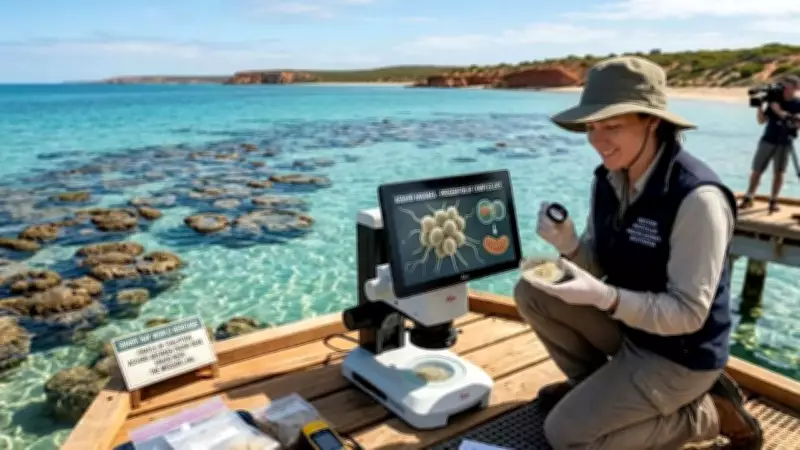
Asgard Archaea Uncovered in Shark Bay: A Breakthrough in Evolutionary Science
In a groundbreaking discovery, scientists have identified an archaea known as 'Asgard' within the hypersaline waters of Shark Bay, Australia. This finding sheds light on a centuries-old evolutionary puzzle: how did simple, single-celled bacteria evolve into complex multicellular organisms, including animals and humans? These unique microorganisms act as a crucial evolutionary link, possessing cellular machinery once thought exclusive to complex cells, thus pinpointing a key transition in the history of life on Earth.
The Proto-Eukaryote: A 'Living Fossil' Revealing Our Origins
The Asgard archaea, often described as a 'living fossil,' represent the initial microorganisms capable of existing and consuming other primitive microbes. This interaction led to the formation of the first eukaryotic cell. Without this microscopic ancestor, discovered in Australia's hypersaline basins, the evolutionary branch that gave rise to humanity might never have developed. According to a study published in Nature, the identification of Asgard archaea in Shark Bay's microbial mats confirms they are the closest living relatives of eukaryotes, organisms with complex cells like those in humans.
Eukaryotic Signature Proteins and DNA Analysis
The Asgard archaea contain what are termed 'eukaryotic signature proteins' (ESPs), which provide the molecular scaffolding necessary for intracellular architecture. DNA analysis further supports that these archaea represent the eukaryotic progenitor, establishing a direct evolutionary lineage from this unicellular organism to modern humans. This discovery bridges a significant gap in our understanding of cellular evolution.

Endosymbiosis: Fueling the Rise of Multicellular Life
Research on Asgard archaea bolsters the endosymbiotic theory, as detailed in PNAS. This theory posits that endosymbiosis began when an Asgard-like organism engulfed unrelated bacteria. Instead of digesting them, the larger cell and bacteria coexisted symbiotically. Over millions of years, the engulfed bacteria evolved into mitochondria, the cellular 'engines' that provide the metabolic surge essential for the development of multicellular organisms.
Bridging the Two-Billion-Year Gap in Shark Bay
The microbial mats and living stromatolites in Shark Bay, a World Heritage site, thrive in waters with twice the salinity of open oceans. This ancient environment mirrors the conditions of Earth's oceans from two billion years ago, allowing scientists to observe a modern analog of the settings that fostered complex life. The Asgard archaea inhabiting this niche are considered 'missing links,' exhibiting evolutionary plasticity that helps explain the transition to more advanced life forms.
The Hidden Complexity of Simple Microbes
Additionally, Asgard archaea possess a unique cytoskeleton compared to standard prokaryotic cells, enabling shape transformation, movement, and internal material transport. As per the Journal of Molecular Biology, these features were once believed to be solely associated with complex life. Thus, they provide evidence that the cellular biomechanics required for environmentally dependent life forms existed long before the first animals appeared.