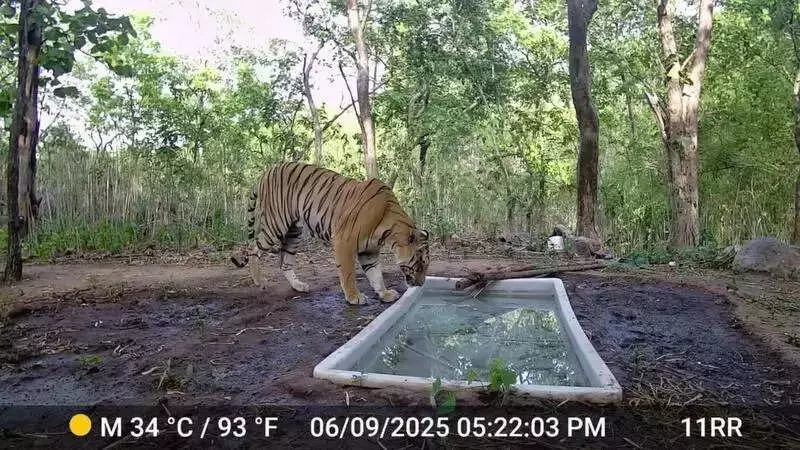
In a historic wildlife development that has excited conservationists across India, Gujarat's forest department has officially confirmed the presence of a tiger in the Ratanmahal sanctuary area, marking the return of the big cat to a state where it was declared extinct more than two decades ago.
The Official Notification and Tiger's Journey
The Gujarat forest department sent an official communication to the National Tiger Conservation Authority (NTCA) on Monday, confirming that a tiger has established itself in the Ratanmahal region for the past nine months. The big cat is believed to have wandered into Gujarat from neighboring Madhya Pradesh and has successfully adapted to its new environment.
This development is particularly significant as tigers were officially declared extinct in Gujarat by 2001, with the last known tiger believed to have died around 1985. While the 1999 census had recorded some tiger pug marks, the species was officially declared extinct shortly thereafter.

Conservation Measures and Future Plans
Forest department officials have documented the tiger's successful adaptation through confirmed kills and are implementing comprehensive measures to ensure its long-term survival. These measures include introducing prey species such as chital and sambar deer to support the tiger's dietary needs.
Gujarat has now formally requested NTCA's intervention to designate Ratanmahal as a tiger reserve, which would provide a comprehensive legal and administrative framework for protecting tigers and their habitats. "This request is part of a broader strategy to ensure the long-term viability of tigers in the region," an official stated.
The state government has also sought Ratanmahal's inclusion in the Tigers Outside Tiger Reserves (TOTR) project, a nationwide initiative spanning 80 forest divisions across 17 states that focuses on managing human-wildlife conflict and enhancing prey bases in non-reserve areas.
Breeding Plans and Reserve Requirements
In an ambitious conservation move, officials revealed intentions to introduce a female tiger to establish a breeding pair in the sanctuary. However, declaring Ratanmahal as a full tiger sanctuary will require time and specific conditions.
An official explained that "declaring Ratanmahal as a tiger sanctuary will take time, as a stable population of at least eight tigers is required. Recognizing it as a potential tiger sanctuary is the immediate priority."
The state government has urged NTCA, which oversees tiger conservation nationwide, to monitor the situation closely and provide technical support. Earlier this year, a team from NTCA led by assistant inspector general of forests Hemant Singh had visited Ratanmahal to assess its suitability for tiger conservation under the TOTR project, though the tiger's presence wasn't disclosed at that time.
With this development, Gujarat now hosts three major big cat species: lions, leopards, and tigers, creating a unique conservation scenario in the state. The tiger's prolonged stay and successful adaptation have rekindled hopes for the species' permanent return to the region after decades of absence.