

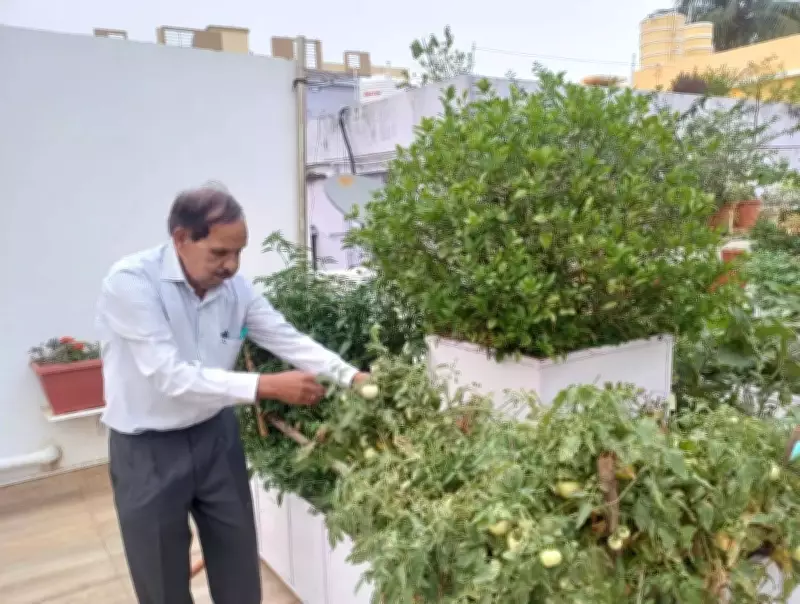
At 76, Odisha Man's Rooftop Garden Serves as Natural Farming Laboratory
In the urban landscape of Bhubaneswar, 76-year-old Sabhapati Khadanga begins each morning tending to what he calls his "laboratory of natural farming"—a vibrant rooftop garden at Jagamara. This expansive terrace garden is a flourishing ecosystem of flowers, fruits, and vegetables, all cultivated without a single drop of chemical fertilizer or pesticide.
Organic Formulations from Kitchen Waste
Khadanga relies entirely on kitchen waste and locally available natural materials to create his own biofertilizers and biopesticides. His extensive repertoire includes:
- Vermicompost and azolla for soil enrichment
- Eggshells and fish extracts for nutrient supplementation
- Mohua flowers and aloe vera fermentation for plant health
- Jeevamruta formulations to improve soil microbiology
- Multi-grain extracts to support robust plant growth
- Banana-peel fermentation and neem-based fertilizers
- Fish tonic to prevent leaf withering in fruit plants
To address the persistent challenge of monkey intrusions, Khadanga developed an innovative solution he calls "Monkey's Puzzle"—a pungent mixture of cow urine, garlic, and neem leaves whose fermented aroma effectively deters the animals.

Diverse Plant Varieties and Seed Preservation
The rooftop garden boasts an impressive 22 varieties of plants, creating a miniature agricultural ecosystem that includes:
- Staple vegetables: maize, pumpkin, chilli, brinjal, tomato, radish
- Leafy vegetables and bitter gourd
- Root crops like yam and onion
- Fruit plants including lemon and amla
- Various beans and scented flowering plants
Khadanga maintains complete seed independence by collecting indigenous varieties and preserving seeds from each harvest for subsequent planting cycles, never purchasing commercial seeds.
Educational Background and International Influence
An MSc graduate in agriculture from Odisha University of Agriculture and Technology (1972), Khadanga initially worked in the private sector before pursuing a diploma in rural development in the United Kingdom in 1984. His exposure to the UK's emphasis on natural farming methodologies profoundly shaped his agricultural philosophy.
In 1991, he received a prestigious UK fellowship focused specifically on natural farming, which he credits with deepening his practical work in developing and field-testing organic formulations—experiments he continues in his personal garden laboratory.
Advocacy Against Chemical Dependency
"When I began working on natural farming, the entire country was entering a different era of chemical fertilizer and pesticide use to dramatically increase crop yields," Khadanga reflects. "Now we find ourselves entangled in a web of pesticides, and escaping this dependency will not be easy. Every household should establish kitchen gardens in their backyards or on rooftops and embrace natural farming practices."
Professional Contributions and Family Life
Originally from Bhanjanagar in Ganjam district, Khadanga now resides in Bhubaneswar with his family. His son, Colonel Manas Khadanga, serves in the Indian Army, while his daughters pursue careers in banking and education.
Professionally, Khadanga serves as a national resource person with the National Institute of Rural Development and Panchayati Raj in Hyderabad. He advises numerous organizations and farmers on transitioning to natural farming methods, regularly traveling across Odisha to encourage cultivators to reduce chemical dependencies and move toward pesticide-free food production.
His work represents a growing movement toward sustainable agriculture that prioritizes environmental health alongside food security, demonstrating that age is no barrier to innovation in ecological farming practices.






