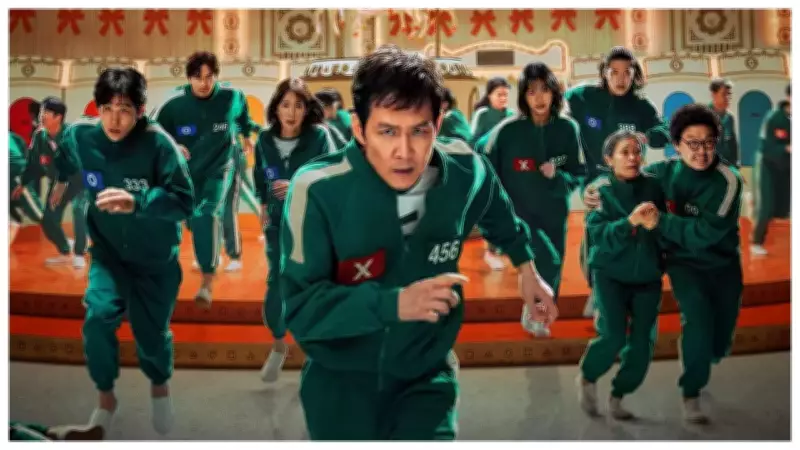
The global phenomenon that is 'Squid Game' concluded with the dramatic fate of Player 456, yet the enigma surrounding its creation continues to captivate audiences worldwide. While the series has officially wrapped up, persistent questions about its potential real-world foundations remain a subject of intense debate and fascination among fans and critics alike.
Creator's Clarification and Global Resonance
Series creator Hwang Dong-hyuk has consistently emphasized that 'Squid Game' is a work of fiction, not based on actual events. However, the show's unsettling exploration of financial desperation and societal inequality has inevitably sparked numerous conspiracy theories and speculative discussions about possible inspirations drawn from reality.
In a revealing June 2025 interview with The New York Times, Hwang shared his perspective on why the series achieved such remarkable global popularity. "We touched something in the zeitgeist through Squid Game," he explained. The director elaborated that framing complex social inequalities through the lens of childhood games created a universally accessible narrative, enabling viewers across cultures to empathize with protagonist Seong Gi-hun's struggles.

The Ssangyong Motor Strike Connection
One of the most compelling real-life parallels to Gi-hun's backstory emerges from South Korea's turbulent Ssangyong Motor Strike. Although 'Squid Game' remains fictional, Hwang has acknowledged drawing creative inspiration from the violent confrontations that erupted following mass layoffs, which escalated into dramatic conflicts between the working class and authorities.
During a 2021 interview with Agence France-Presse, the director articulated his vision: "I wanted to show that any ordinary middle-class person in the world we live in today can fall to the bottom of the economic ladder overnight." Hwang further emphasized that the theme of economic disparity transcends cultural boundaries, resonating with audiences globally.
The Brothers Home Controversy
Another theory that gained significant online traction involves comparisons between the show's vividly colored, labyrinthine game facility and South Korea's historical welfare detention centers known as the Brothers Home. According to historical reports, this now-notorious institution operated in Busan during the 1970s and 1980s.
Initially established as part of a state-supported program to address homelessness, the Brothers Home quickly devolved into a site of horrific violence and systemic abuse. Survivors have shared harrowing accounts detailing forced labor, kidnappings, sexual violence, and even cases where detainees were beaten to death or left to perish from untreated injuries.
Viral Misinformation and Fact-Checking
Social media platforms were flooded with images purportedly showing the interior of the inspiration for the 'Squid Game' compound, featuring distinctive bunkers, staircases, color schemes, and elongated corridors. These visuals spread rapidly, fueling speculation about direct connections to historical locations.
However, investigative reporting by Aljazeera revealed that fact-checking organizations subsequently confirmed many of these circulating images were artificially generated using AI technology rather than authentic historical photographs of the Brothers Home or similar facilities. This viral misinformation prompted several South Korean agencies to actively counter these false allegations and clarify the historical record.
Primary Creative Influences
Despite the proliferation of elaborate fan theories linking the series to real-world events, creator Hwang Dong-hyuk has clarified that 'Squid Game's dystopian narrative was primarily inspired by Japanese survival manga and cinematic works rather than specific historical tragedies. The director has explicitly cited influential manga series including:
- 'Kaiji: Ultimate Survivor'
- 'Liar Game'
- 'As the Gods Will'
These creative sources provided foundational elements for the show's high-stakes games and psychological tension, demonstrating how fiction often synthesizes multiple artistic influences rather than directly mirroring reality.