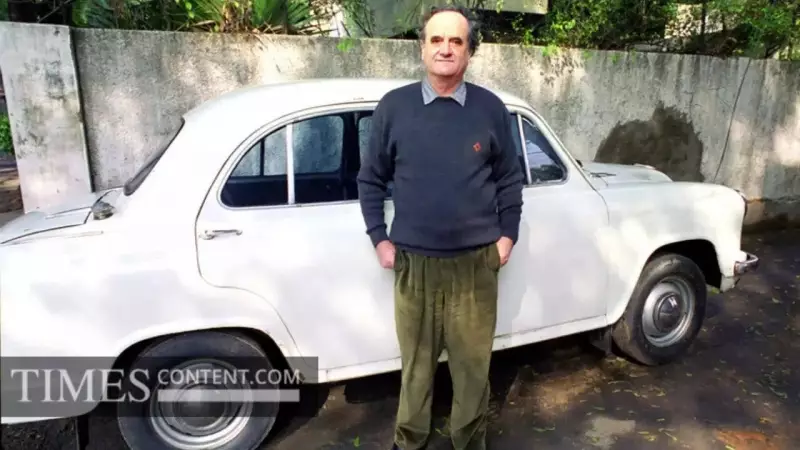
The world of journalism mourns the loss of a towering figure as Sir Mark Tully, the British-born journalist whose name became synonymous with insightful reporting from the Indian subcontinent, passed away on Sunday. He was 90 years old. Tully breathed his last at Max Hospital in Saket, Delhi, where he had been admitted last week after a period of declining health.
A Life Deeply Intertwined with India
Born in 1935 in Tollygunge, Kolkata, to British parents, Mark Tully's connection with India began in his earliest years. He spent his formative childhood on Indian soil, though the colonial era restrictions of the late 1930s initially prevented him from mingling with local communities. This early separation made his later immersion into Indian society all the more remarkable.
His educational journey took him from a boarding school in the misty hills of Darjeeling to England for further studies. In a poignant 2001 BBC interview following his knighthood announcement, Tully contrasted his experiences, recalling England as "a very miserable place… dark and drab, without the bright skies of India." This sentiment foreshadowed his lifelong attachment to the subcontinent.

The BBC Years: Chronicling History Unfolds
The British Broadcasting Corporation became the bridge that permanently reconnected Tully with India in 1964 when they appointed him as their New Delhi correspondent. This assignment marked the beginning of an extraordinary relationship that would span nearly three decades with the broadcaster.
His career witnessed a temporary interruption in 1969 when the Indian government banned the BBC following the airing of Phantom India, a French documentary critical of the nation. Tully was recalled to London but made a triumphant return to Delhi in 1971, ascending to the position of BBC's South Asia bureau chief the following year.
Witness to Defining Historical Moments
Throughout his distinguished career, Mark Tully positioned himself at the epicenter of South Asia's most transformative events. His reporting portfolio reads like a chronology of the region's modern history:
- The 1971 Bangladesh Liberation War and subsequent independence
- The Internal Emergency declared in India (1975-1977)
- The controversial execution of former Pakistani President Zulfikar Ali Bhutto
- Operation Blue Star at the Golden Temple in Amritsar
- The tragic assassination of Prime Minister Indira Gandhi
- The devastating anti-Sikh riots of 1984
- The shocking killing of former Prime Minister Rajiv Gandhi in 1991
- The demolition of the Babri Masjid in Ayodhya in 1992
Literary Contributions and Critical Perspective
Beyond broadcasting, Tully established himself as a thoughtful author who captured India's complexities through both fiction and non-fiction. His first book, Amritsar: Mrs Gandhi's Last Battle (1985), co-authored with Satish Jacob, provided a meticulous examination of Operation Blue Star and the Punjab crisis.
In his seminal work No Full Stops in India (1988), Tully offered a critique of Western perspectives, writing: "The stories I tell in this book will, I hope, serve to illustrate the way in which Western thinking has distorted and still distorts Indian life." This reflection demonstrated his nuanced understanding of cultural interpretation.
His literary journey continued with ten books including India in Slow Motion (2002), India's Unending Journey (2008), and India: The Road Ahead, each contributing to a richer understanding of the nation he called home.
Accolades and Recognition
India formally acknowledged Tully's contributions with the Padma Shri in 1992, followed by the Padma Bhushan in 2005. The British government knighted him in 2002, creating the unique distinction of Sir Mark Tully. Despite these honors, he remained characteristically humble and committed to his craft.
Post-BBC Career and Lasting Legacy
Tully parted ways with the BBC in 1994 after publicly criticizing the organization's internal culture, but his connection with broadcasting continued. He hosted the spiritual program Something Understood on BBC Radio 4 until 2019, demonstrating his multifaceted interests beyond hard news.

He maintained his residence in Delhi, working as a freelance journalist and continuing to observe and comment on India's evolving story. On his 90th birthday in October, his son Sam Tully captured his father's dual heritage beautifully on LinkedIn: "I think my father's achievements are particularly significant for UK-India ties because of his abiding ties and affection for both countries… 'Dil hai Hindustani, magar thoda Angrezi bhi!'"
Mark Tully's passing marks the end of an era in journalism, leaving behind a legacy of balanced reporting, cultural sensitivity, and an unparalleled chronicle of India's journey through the late 20th century. His voice, both on air and in print, provided generations with a window into the soul of a nation in transformation.