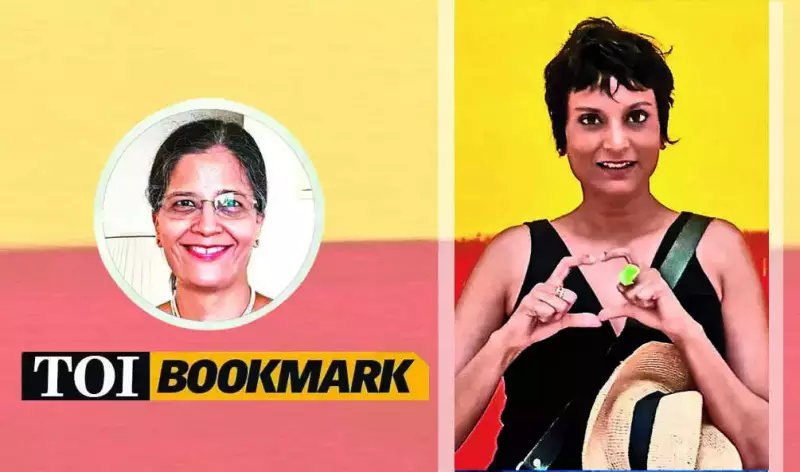
Author Pallavi Aiyar Unveils Deeply Personal Journey in New Book
In a revealing interview, acclaimed journalist and author Pallavi Aiyar opens up about the profound personal experiences that shaped her latest literary work. The book, which she describes as her most personal to date, emerged from what she calls her "annus horribilis"—the difficult year of 2023.
A Year of Profound Challenges
Aiyar received a shocking breast cancer diagnosis in 2023, a life-altering event that forced her to confront mortality and vulnerability. As she navigated the arduous treatment process, tragedy struck again when her mother passed away suddenly. "I spoke to her the night before, and then the next morning I got a call saying she's gone," Aiyar recalls, describing how these events left her feeling completely unmoored.
Yet from this darkness emerged creative inspiration. The author began contemplating how to traverse the inner terrains of illness and grief, drawing parallels between these emotional journeys and her extensive physical travels. Having lived in eight countries across nine different cities since the late 1990s, Aiyar realized she could apply lessons from geographical exploration to metaphorical life journeys.

"Recasting illness and recasting grief as plot really helped me to process them," she explains. "It allowed me to bring to these experiences an openness and curiosity that I normally reserve for my travels to new countries."
The Complex Politics of Passport Privilege
One particularly compelling chapter addresses what Aiyar terms "passportism"—a hierarchical system that determines who can travel freely and who faces barriers. She draws a striking parallel between this modern privilege and ancient caste systems, noting that both are largely determined by birth.
"It's a throw of the cosmic dice whether you're born in Sudan or whether you're born in the US," Aiyar observes. "But if you happen to be lucky enough to be born in the US or Spain, you have the keys to the world."
Despite being married to a Spaniard with a European passport for 25 years—placing her in what she calls a "family of passport Brahmins"—Aiyar has consciously retained her Indian passport. She explores the complex motivations behind this choice, which extend beyond simple national loyalty.
"There's this kind of sense of guilt almost that I have of being such a privileged Indian," she admits. The author notes the irony that while Western liberal societies rightly condemn racism, sexism, and casteism, passport discrimination remains widely accepted, even celebrated through annual passport rankings that publicly declare which nationalities enjoy the greatest mobility.
Motherhood and Journalism: Breaking Artificial Barriers
Aiyar challenges traditional divisions between personal and professional life, particularly regarding motherhood and journalism. She argues that the expectation for journalists to maintain objective distance while relegating motherhood to the private sphere is both disingenuous and counterproductive.
"I believe this kind of division between the personal and the professional is spurious," she asserts. "It does not serve the interests of not only women, but men either."
The author critiques the tradition in foreign correspondence and travel writing of white male writers assuming an objective vantage point, obscuring their particular lenses behind an authorial, universalistic voice. Instead, Aiyar advocates for transparency about one's subjectivity.
"Whenever we are talking about something, we are describing a version of the truth," she explains. "That version is very much determined by who is telling that story. So you are a female, you are a mother. And that is why you are apprehending the world in that way."
She particularly takes issue with the impossible expectation encapsulated in the phrase "women can do it all," which she interprets as: "When you're at work, you pretend that you don't have kids, and when you are with the kids, you have to pretend that you don't have work."

From Tiger Mom to Balanced Parenting
Aiyar candidly discusses her own parenting evolution, including what she describes as a "misguided phase" of embracing the "Asian tiger mom" approach inspired by Amy Chua's controversial book "Battle Hymn of the Tiger Mother."
"I went through a very misguided phase of being this tiger mom until I realized I was creating misery all around," she confesses. "After a few months, I felt my claws retract and the stripes on my body dissolved into colourful polka dots."
Having spent the last five years in Spain, Aiyar now observes a different parenting extreme—one so relaxed about academics that she sometimes wishes for more academic focus. This experience has led her to appreciate the importance of cultural context in parenting approaches and the value of finding a balanced middle ground.
Travel as Expansion of Self
Throughout the interview, Aiyar returns to the transformative power of travel, which she views not merely as geographical movement but as expansion of perspective and self. She illustrates this through the metaphor of her Chinese name, which represents an additional lens through which she can interpret the world.
"When you travel, you learn new languages, you experience new cultures, and you understand there's so many different ways in which you can inhabit the world," she reflects. "Hopefully you can accrue more and more of these lenses so that you become a wider person."
Yet Aiyar remains mindful of the privilege inherent in international travel, circling back to her earlier discussion of passportism. She suggests alternative forms of exploration available to those with mobility restrictions, including becoming a traveler in one's own neighborhood by approaching the familiar with fresh curiosity.
The author even applies this philosophy to the various mispronunciations of her own name—from "Pullover" to "Pavlova"—choosing to embrace each iteration as "just one more way of being." This attitude encapsulates her broader approach to life's journeys: meeting challenges with openness, curiosity, and a willingness to be transformed by experience.