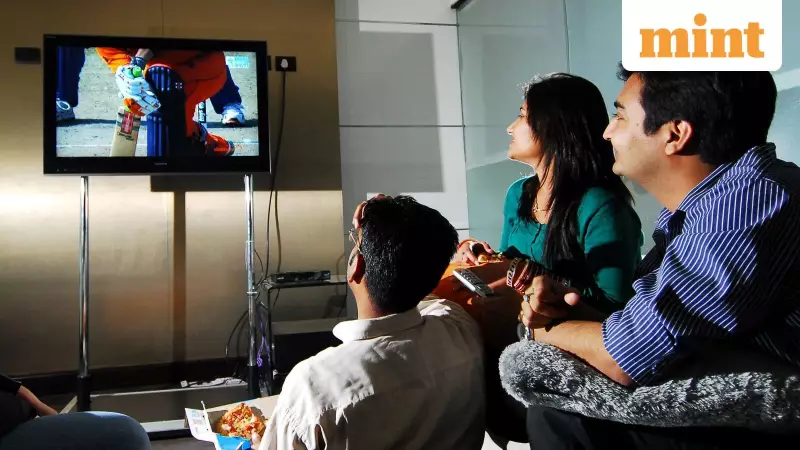
News television is making a quiet comeback in the era of doomscrolling. Connected televisions are gradually shifting viewership from handheld devices to larger screens across India. This resurgence of the big screen reveals a clear split in digital consumption patterns.
The Big Screen Returns
While doomscrolling drives short, frantic views on social media through smartphones, long-format videos are steadily reviving viewership in living rooms. Platforms like YouTube and creators across the country are preparing for this significant shift. Long-format content now finds an unlikely coexistence with the shrinking attention spans of the mobile era.
Connected TVs are prompting creators and platforms such as YouTube and MX Player to produce engaging vlogs, podcasts, movies, and web shows. These are increasingly being made in the 4K format, which is perfectly suited for the bigger screen. Internet-enabled television now reaches over 75 million adults in India, according to recent data from YouTube. Notably, over 50% of watch time in India is spent on content longer than 21 minutes.

A Fundamental Shift in Consumption
"Connected TV has consistently been our fastest-growing screen in India, and its impact on the digital ecosystem is profound," stated Gunjan Soni, the managing director of YouTube in India. "We are witnessing a fundamental shift in how India consumes content. The personal, lean-forward experience of the smartphone now coexists with the collective, lean-back experience of the living room."
To boost discovery and commerce on the larger screen, YouTube has rolled out new features. These include personalized recommendations and seamless phone-to-TV sharing capabilities.
Connected TVs Go Mainstream
India's smart TV sales, which declined in 2023 and 2024 due to high inflation, are estimated to have shown modest growth in 2025. This data comes from the tech market researcher Counterpoint. Demand is projected to expand at a 5% compound annual growth rate through 2030.
This growth is driven by increased penetration in Tier 2 cities and beyond. Factors like recent goods and services tax rate cuts and the expansion of rural broadband via BharatNet are fueling this expansion. "Starting in 2026, the Smart TV market is projected to resume steady growth as inflation moderates," noted Tarun Pathak, research director at Counterpoint Research.
He added that demand for premium features, including mini-LED and AI capabilities, will accelerate. This is especially true in tier-3 and tier-4 markets. In comparison, Counterpoint expects a flat to slight decline in smartphone sales for 2025, to around 152-153 million units. This marks four straight years of stagnant demand.
Buyers are holding on to their smartphones for longer periods. Feature phone users are not upgrading quickly, and the secondary and refurbished phone market is growing.
Infrastructure Supporting the Shift
The number of home broadband connections in India surged over 2.5 times to 59 million in the five years through November 2025. This data is from the telecom regulator. Along with expanding fibre-to-the-home connections, telecom operators have been offering 5G fixed wireless access to connect more households.
Tablets are also blending mobility with larger displays. India shipped 1.33 million tablets in the third quarter of 2025, according to International Data Corp. While this represented a yearly decline, consumer sales actually surged 13.5%—the strongest growth in over a decade. Deep discounts drove a 53.9% year-on-year growth in festive sales for online electronic retailers.
"Tablets are increasingly emerging as a viable device for both content consumption and creation," said Navkendar Singh, associate vice president of IDC.
Creators and OTT Platforms Chase the Opportunity
Platforms are now offering higher payouts to creators to develop longer videos. The demand for long-form content is high, and there is an initial scarcity of material truly suitable for connected TVs. Such content is proving to be more rewarding for creators.
According to Ayush Guha, Business Head at influencer management agency Creator 18, advertisement revenue from YouTube for viewership on TV is over double what creators receive from mobile and tablet views. Desktop viewing revenue falls somewhere in between.

"As people are consuming so much content, they are also looking for value addition," Guha explained. "They want to gain knowledge from videos that teach. Such content also performs very well." He advised creators to seriously look at long-form content, even if they originally gained fame through short-form viral videos.
Building Intellectual Property
Some creators are now expanding into high-value projects. They are building their own intellectual properties in the form of fiction and even reality shows. Popular creator Ashish Chanchlani created the sci-fi web series Ekaki and released it directly on YouTube. The first four episodes, which are already live, averaged around 25 million views each.
Amazon’s MX Player is actively embracing fictional content from creators. The platform is producing many ‘mini-web series’ in collaboration with them. Reality TV-like shows, often featuring comedians and creators, are also gaining significant popularity.
"We produced our first concept show—The Pretty Good Roast Show by Aashish Solanki—in 2024," said Manmeet Singh, production head at Playpause Studio. "We spotted a clear gap in IP-led long-format comedy despite growing demand on YouTube."
As that roast show and others like India’s Got Latent gained popularity, the studio dove deeper into long-format productions. They have created 12 shows in the past two years.
"While mobile continues to drive the bulk of consumption in India, long-form viewing on connected TVs has been steadily growing, especially on YouTube," Singh observed. "If creators can retain attention, long-format content is significantly more monetizable. We now have 20 more long-format shows, including a fictional series, in the pipeline. These are designed specifically for TV and OTT audiences."